Agentic coding workflows use AI agents to write code, run shell commands, and ship changes with minimal human input. That autonomy accelerates delivery, but also gives agents room to introduce bugs, expose secrets, or push unsafe code before anyone reviews it.
Agentic coding guardrails contain those risks. They're the permission boundaries and verification layers that constrain what AI coding agents can do, catch what agents get wrong, and hold every change to your team's standards before your code reaches production.
While generic AI guardrails filter harmful content and moderate what a model says back to a user, agentic coding guardrails govern what an autonomous agent does inside a repository. They control, verify, and sometimes block actions like file writes, shell commands, git operations, API calls, and interactions with external services.
The rest of this guide covers the seven controls that span both feed-forward and feedback loops, where each one fails in practice, and how to evaluate whether your stack can structurally block bad code from reaching production.
Why ungoverned agents break things
Ungoverned agents scale their mistakes as fast as their output. Without permission boundaries and verification layers, agents act on incomplete context and unchecked authority. The result is security vulnerabilities at scale, silent correctness bugs, and review work piling onto senior engineers.
A scan of more than 1,400 AI-coded production applications found widespread security issues, including critical vulnerabilities and exposed secrets. Common Vulnerabilities and Exposures (CVEs) tied to agentic AI systems are also rising sharply year-over-year. Agents with broad write access turn one bad decision into a production incident.
Correctness bugs can be subtler and harder to catch. Columbia University's DAPLab analyzed the leading agentic coding tools and found error handling and business logic bugs were the most dangerous because they are silent. The code runs without errors. The application doesn't do what was specified. CodeRabbit's review of 470 PRs found AI co-authored pull requests produce 1.7 times more issues per pull request (PR) than human-only code. Within that, logic and correctness findings run 75% higher, and null-pointer dereferences appear more than 2.2 times more often.
Lastly, the review bottleneck lands on the people who can least afford it. 84% of developers report using or planning to use AI tools, and trust in output accuracy remains mixed. Coding speed gains are often absorbed by bottlenecks in testing, security reviews, and deployment that teams didn't scale alongside AI adoption. Verification becomes the scaling constraint, and the engineers most qualified to verify are the ones already constrained.
Guardrails for agentic coding workflows address all three issues. For example, permission boundaries contain security blast radius, independent verification catches silent correctness bugs, and layered enforcement takes pressure off the senior engineers carrying the review load.
The 7 core guardrails for agentic coding workflows
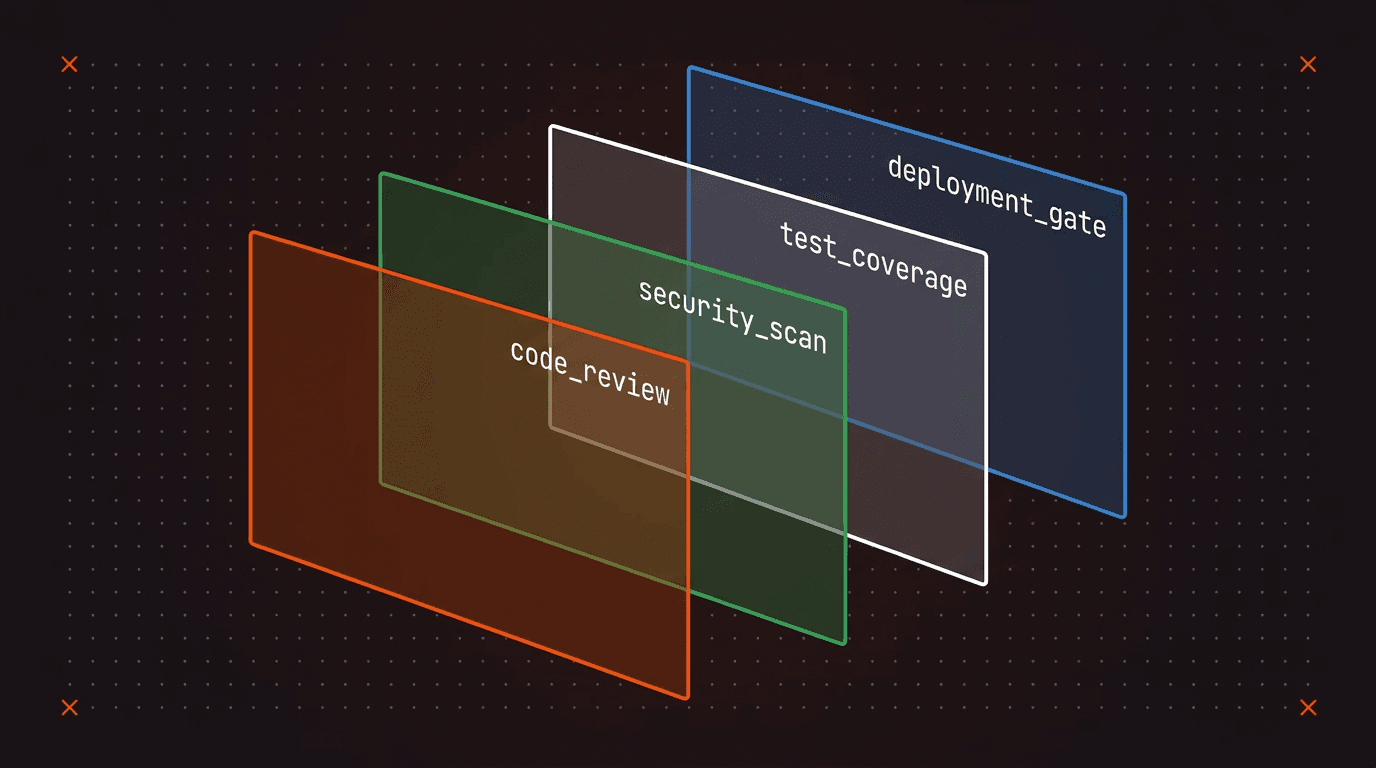
Guardrails for agentic coding workflows split into two complementary loops. The preventive (inner) loop shapes generation before it happens through permission scoping, context engineering, and behavioral specifications. The detective (outer) loop observes what the agent actually produced through linters, static analysis, sandboxing, and independent review.
Seven controls span both loops. Evaluate each against three questions: can the agent bypass it; if it does, is the bypass visible or silent; and if visible, is there a recovery path? Detectability without recoverability is just a better post-mortem.
Two notes on the outer loop. First, "independent review" sits apart from the automated tools around it. It differs in latency, cost, coverage, you should treat it as a separate category rather than a peer to static analysis. Second, any control described as spanning both loops needs to show its work: what does it prevent, what does it detect, and under what conditions does it do each?
1. Permission scoping and deny-first rules
Permission scoping defines what an agent can touch before it runs. The deny-first evaluation pattern, used by Claude Code, for example, ensures anything not explicitly permitted is blocked. IronCore Labs documents their organizational policy: agents may not automatically push to main or protected branches, direct production database access is prohibited, and access to .env files and ~/.ssh/ directories is explicitly forbidden.
A practical deny-first configuration blocks reads against /.env*, /secrets/, /.ssh/, and /credentials/, and routes git pushes and writes through an ask-first prompt.
The guardrail fails when permission rules can be bypassed by wildcard matching. Claude Code patched a vulnerability where wildcard rules like Bash(npm run *) could match compound commands containing shell operators, meaning an agent running npm run build && rm -rf / would pass the check. Permission rule syntax itself is an attack surface.
2. Context engineering and agent instruction files
The second feed-forward layer shapes what the agent sees during generation. We define context engineering as the difference between an AI code review tool that merely pattern-matches against generic coding standards and one that deeply understands your project's specific architecture, patterns, and goals – and can actually add value to your code review.
Agent instruction files (CLAUDE.md, .cursorrules, AGENTS.md) operationalize this. The pattern that works: treat the file as onboarding documentation for a new engineer, with direct action-oriented language and explicit hard constraints. Imperative phrasing ("YOU MUST run this scan after every file edit") keeps the rule firm. Optional phrasing ("consider running") gets treated as a suggestion the agent can skip.
The unsolved operational problem: teams running multiple coding tools in parallel maintain separate convention files (.cursorrules, CLAUDE.md, .github/copilot-instructions.md, CI script system prompts) that drift.
Practitioners on r/ExperiencedDevs describe the same week-to-week pattern. Someone updates one file, forgets the others, and the agent starts suggesting banned patterns because the file that particular tool reads is stale.
3. In-loop deterministic sensors
In-loop sensors catch structural problems during generation, not after. Thoughtworks draws the distinction between inferential and computational sensors. Inferential sensors ask the agent to interpret a signal, which is inherently subjective. Computational sensors (linters, type checkers, dependency analyzers) return unambiguous pass/fail. Once objectivity and consistency are required, computational sensors are the only reliable option.
ESLint configurations can flag patterns common in AI-generated code — complexity: ["error", { "max": 10 }], max-depth: ["error", 4], and max-lines-per-function: ["error", { "max": 50 }] catch high cyclomatic complexity and deeply nested logic.
The sensor fails when agents can suppress its output. Inline-disable rules such as // eslint-disable-next-line let the agent route around the violation instead of fixing it. Disable inline suppression in agent workflows.
4. Pre-merge CI and static analysis gates
AI-generated code goes through the same continuous integration (CI) system that validates human commits, not a separate, lighter-weight pipeline. One pipeline, one set of gates, regardless of who or what wrote the code.
The gates that matter for AI-generated code:
- Static application security testing (SAST) on every PR
- Secret scanning capable of detecting custom patterns
- Test coverage gates as a prerequisite for merge, not a quality metric
- Branch protection rules preventing direct pushes to
mainor protected branches
The gate fails when it’s weak. Agents facing failing tests will delete them to pass CI. The response is structural enforcement, not advisory. Coverage gates must block merge, not warn.
Policy-as-code tools like Open Policy Agent (OPA) extend the same enforcement model to declarative compliance rules, running before code reaches CI.
5. Independent code review
Authoring-side guardrails and sandboxing leave one gap. Code that compiles, follows conventions, and looks correct on surface read but is semantically wrong. Research on agentic AI systems characterizes this failure mode as "syntactic plausibility" — the code passes superficial checks because the generating model produced it to pass superficial checks. This is the same pressure point that turns AI pair programming into a review bottleneck.
Self-review by the generating model fails because the model evaluates its own output against the same syntactic surface that produced the error. Research on meta-engineering harnesses draws the distinction between independence-based and attention-based verification. Asking the same model to look again reduces attentional blindness but preserves implementation blindness. An independent review with no shared context addresses both.
CodeRabbit fills the independent review position. The platform reads .cursorrules, CLAUDE.md, and AGENTS.md from the repository and applies them as review criteria, so the rules governing how agents write code also govern how every PR gets reviewed. Code Guidelines bridge authoring-side intent to review-side enforcement, partially solving the convention drift problem from guardrail #2. The Request Changes workflow makes CodeRabbit a required reviewer that can structurally block merge until issues resolve.
Abnormal AI's 250-engineer team ran into the implementation-blindness problem directly when running background agents across an AI-native playbook. Using CodeRabbit as the independent review layer for both AI-generated and manually written code, the team saw an acceptance rate above 65% on critical-severity comments.
6. Sandboxing and runtime isolation
Sandboxing constrains the blast radius of agent actions. NVIDIA Developer documents the foundational principle: the only reliable boundary is sandboxing the code execution environment. Sanitization alone fails because attackers continuously craft inputs that evade filters.
Production sandbox architectures use OS-level primitives. Anthropic's Claude Code sandbox is built on Linux bubblewrap and macOS seatbelt, with filesystem access restricted to the working directory and all network traffic routed through an external proxy enforcing domain allowlists. Stronger isolation tiers like microVMs (Firecracker, Kata Containers) and user-space kernel isolation (gVisor) are also production-grade for higher-risk workloads.
Sandboxing does not stop semantic manipulation within the permitted scope. A poisoned tool description can instruct the agent to do harm within its allowed permissions. That gap is where independent review and audit trails become non-optional.
7. Audit trails and version control
Audit trails record what agents do in your repository. Without them, incident reviews hit a dead end. Every AI-generated contribution should be committed to version control with clear messages and full traceability.
The minimum data to log: prompts, tool calls, files read and modified, approvals, and the agent identity making each request. Comprehensive logging serves both security monitoring and compliance audits.
The guardrail compounds value over time. Logged data improves both the next audit and the next guardrail iteration. Every failure that reaches review becomes a fix in the gates that should have caught it.
Every guardrail earns its merge
Guardrails for agentic coding workflows require infrastructure-level investment. Teams shipping AI-generated code reliably treat verification as a first-class engineering investment. They use structural gates that agents cannot circumvent on both authoring and enforcement sides. For Slack-native agents, that same infrastructure tradeoff is part of the build vs. buy decision.
Remember, evaluate every guardrail against two questions: can the agent bypass it, and if it does, is the bypass visible or silent?
CodeRabbit fills the independent review position in this stack. It uses context engineering and multi-model orchestration. It also bundles more than 50 linters and SAST tools for pull request enforcement. Across 3 million repositories under review, that enforcement problem shows up as a systems problem, not a one-team problem. Pre-Merge Checks can submit a "Request changes" review to structurally block merge until teams resolve issues. Enforcement becomes architectural.
Cut code review time by 50% and reduce bugs. Available on GitHub and GitLab. Start a free 14-day trial