Your AI-generated pull request passes its tests, but a reviewer still finds a missing authorization check. Before you merge, you need a clear answer: which failures stop the change, and who can approve an exception?
A quality gate answers that question. It defines which requirements a change must meet before it merges and keeps the evidence for each one where reviewers can see it, leaving the authority to approve an exception with someone other than the agent that wrote the code.
What is a quality gate in software development?
Defined criteria and a decision to proceed
A code quality gate is a checkpoint that evaluates a change against your team's acceptance criteria. Those criteria can include passing tests, limits on detected vulnerabilities, coverage requirements, or an approval from a designated reviewer. You decide which conditions apply to each repository and type of change.
The gate connects those results to a release decision. If a required condition fails, the change stops until someone fixes the issue or follows an authorized exception process. A dashboard that only reports failures still needs a repository or pipeline rule to stop the change.
SonarQube's quality gate documentation provides a concrete example. SonarQube evaluates conditions against analysis metrics and returns a pass or fail result. Teams can use that result to fail a CI pipeline or, through the repository integration, prevent a pull request from merging.
A concrete example for AI-generated code
Suppose an agent changes a public API. Your policy requires compatibility tests to pass and breaking changes to be documented. The gate checks both before merge, so a missing documentation update fails the check even if the code compiles and its unit tests pass.
Be sure to write the rule precisely. A rule like “Document breaking changes to public endpoints in the pull request description” gives a reviewer or automated check something specific to evaluate, while “Make sure the change is good” does not.
What changes when AI agents write the code?
AI use rises as trust falls
The 2025 Stack Overflow Developer Survey found that 84% of respondents used or planned to use AI tools in their development process, up from 76% in 2024. Stack Overflow’s accompanying release reported that distrust of AI output accuracy rose from 31% in 2024 to 46% in 2025.
In the survey announcement, Prashanth Chandrasekar, Stack Overflow's CEO, said, "AI is a powerful tool, but it has significant risks of misinformation or can lack complexity or relevance."
Reviewers checking AI output also have more code to read. In its 2026 analysis of 8.1 million pull requests across 4,800 teams, LinearB found that AI-assisted pull requests were about two and a half times larger than unassisted ones, exceeding 400 lines at the 75th percentile compared with 157. LinearB measured change size rather than defect rates, so the data doesn’t show that larger pull requests contain more defects, only that each review has to cover more code.
The reviewer needs evidence beyond the agent's explanation
An agent can plan and implement a change, then test and revise it, before you open the pull request. When the agent explains its work, that explanation helps you understand the proposed approach, but you still need to check it against the requirement, the code, and the test results.
The agent may do the work, but people remain accountable for agent-generated changes. Keep the issue, acceptance criteria, relevant execution records, and validation results available to reviewers. Don’t assume that an agent’s confident account of its work proves the implementation is correct.
Use a separate evaluation step when you need a second assessment. Anthropic's 2024 guidance on building effective agents describes an evaluator-optimizer workflow in which one LLM call generates a response and another evaluates it. Even so, a model reviewing in a separate call can make the same mistakes as the one that wrote the code, so test the review process against the defects your team needs it to catch.
How quality gates work with CI/CD and code review
CI/CD runs checks and enforces their results
CI/CD builds, tests, and delivers your software, and a quality gate uses results from that workflow to decide whether a change can proceed. A required CI test becomes part of the gate when its failure prevents a merge.
Your pipeline can run more than tests. Static analysis, secret detection, dependency scanning, and policy checks can all contribute to the decision.
What the gate covers still depends on the checks you configure and the evidence they inspect. Green CI means those checks passed, but not that every requirement was tested. For example, a test suite can miss an authorization rule, while a documentation check can miss an undocumented API change if its scope excludes the affected endpoint. When a defect exposes a gap, extend the test or review check that should have caught it.
Review findings become a gate when policy makes them binding
Human and AI reviewers identify problems and assess trade-offs. Your repository rules connect their findings to merge permission through required approvals, review-thread resolution, or status checks. An optional comment gives you feedback, while a required approval determines whether the change can proceed.
An automated reviewer can examine code and report findings, while your repository rules determine which results prevent a merge. So be sure to check both the review configuration and the enforcement settings.
Security analysis can also feed a quality gate, and your policy decides which security findings require a fix or an approved exception. A passing security check is still limited by the analysis behind it. Whether the change fits the architecture and solves the right problem falls outside automated checks and requires judgment from people who understand your system.
What makes a quality gate credible for AI-generated code?
Independent review and consistent standards
Give the reviewer access to the requirements, code, and test results, and keep approval authority outside the generating agent’s control. Check what the generation and review steps each evaluate, because switching vendors doesn’t establish independence. Using one vendor for both steps doesn’t prove that the two share every blind spot, either.
Apply the same standards whether a change comes from Codex, Claude Code, Cursor, or a developer. Choose stricter checks for sensitive changes based on their risk, regardless of which tool produced them.
Selective findings and clear explanations
Keep blocking findings tied to requirements and defects that justify stopping a change, and treat minor style preferences as advice unless your team has made them a requirement. Otherwise, developers spend review time disputing preferences instead of fixing defects.
For each failure, show what failed, where to find the evidence, and how to resolve it. A check that names a changed endpoint and its missing compatibility evidence gives you a specific next step, while “API change detected” leaves you to find the problem.
CodeRabbit’s guide to building a quality gate for AI-generated code covers these review principles, configuration, and rollout.
Where to place and audit your quality gates
Give feedback early and enforce before merge
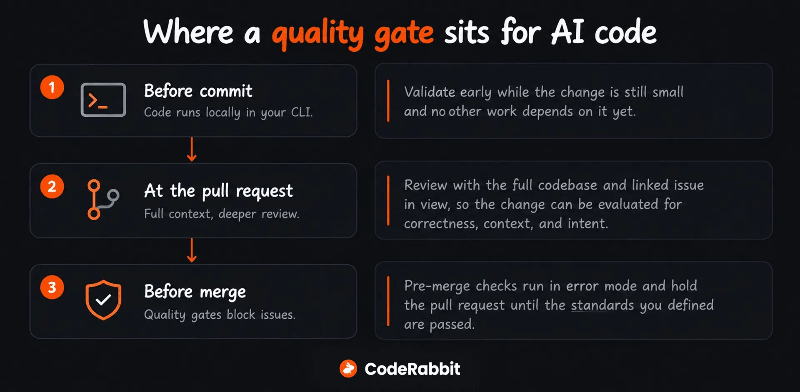
In an agentic SDLC, early local checks help developers and agents fix problems before opening a pull request. Pull request review then brings in the proposed change, linked requirements, and repository context, and required merge or deployment checks enforce the relevant decision. Find the point where a failure stops progress, then confirm that the final check evaluates the revision you intend to ship.
In CodeRabbit, you can disable Pre-Merge Checks or run them in warning or error mode. For results reported in the Walkthrough comment on the pull request, warning mode is the default and reports failures without blocking a merge. Error mode works with Automatic Approvals to withhold approval until you fix or explicitly override the failures. Your repository’s review rules must still enforce the resulting approval requirement.
Inconclusive Pre-Merge Checks reported in the Walkthrough don’t block the pull request. Checks defined in the .coderabbit/pre-merge-checks/ directory and reported as GitHub Check Runs, however, return action_required when inconclusive, which blocks merging if your repository requires that check. Either way, decide who must review missing evidence before your team merges a change.
Verify what your current setup stops
Start with a rule you already have and trace it from the written policy to the merge decision. Then open a test pull request that breaks the rule on purpose, and confirm that the expected check fails and stops the change. After you fix the violation, verify that the change goes through. It’s also worth checking who can override the result and where the exception shows up.
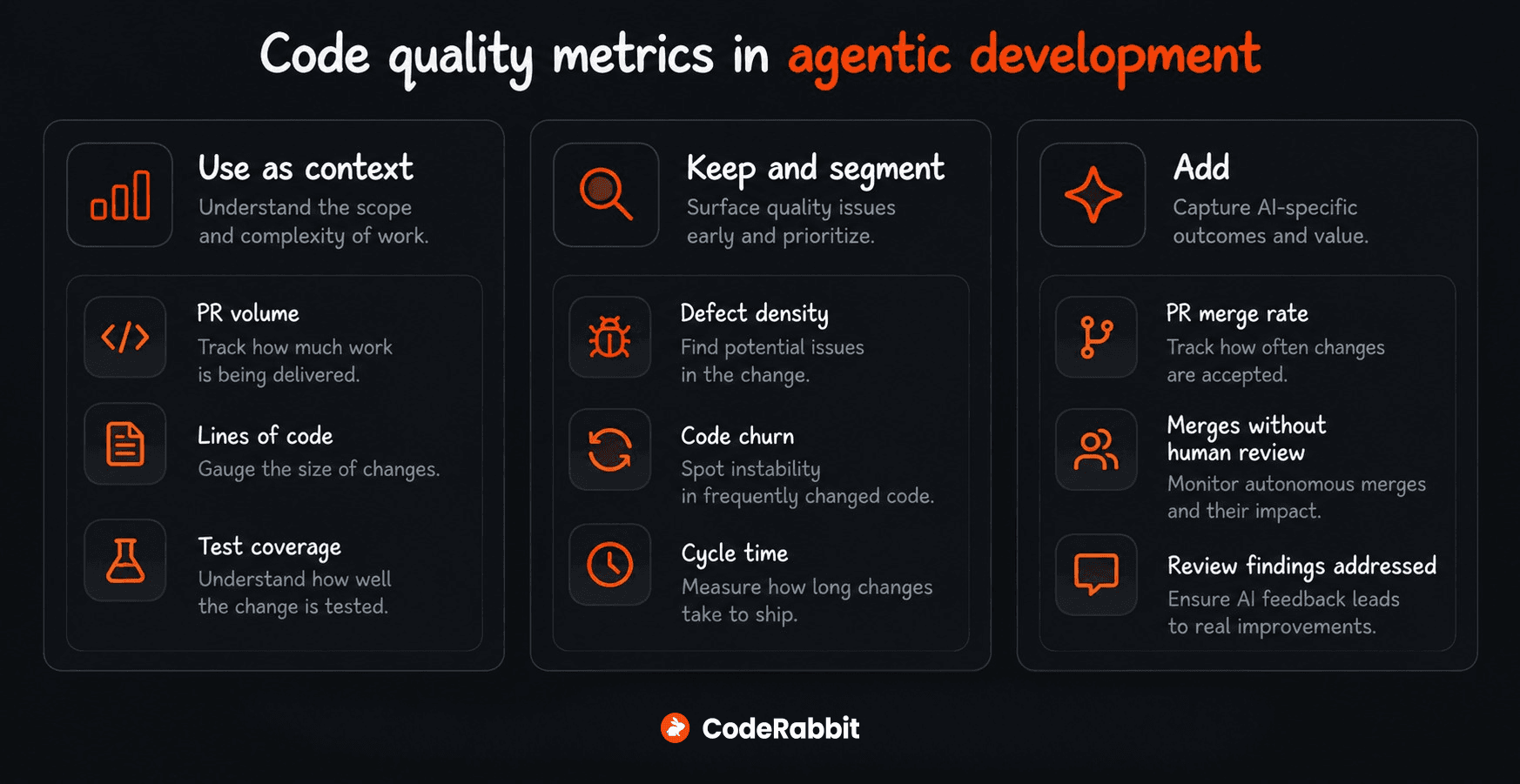
Track the defects that escape after merge as well as the findings caught beforehand. Our guide to code quality metrics for agentic development explains how to connect review signals with defect density and code churn.
Try CodeRabbit on your next pull request and compare its findings with the requirements your team already enforces.