The challenge
Teams using coding agents need prompts that are clear, specific and context-aware. That's exactly why we built CodeRabbit Plan, a collaborative planning tool that turns vague ideas into agent-ready prompts, whether you're starting from a concept, a ticket, or just a text prompt.
Bad prompts cost you – in time, compute and dev hours. Two problems collide here. First, poorly written prompts drag out your SDLC with things like:
Second, crafting high-quality prompts is time-consuming. Teams need to align, clarify and preserve a few components like:
The solution: CodeRabbit Plan
CodeRabbit Issue Planner now becomes Plan. We’re decoupling planning and issue tracking so you can start planning from a concept or a prompt – not just from an existing ticket.
CodeRabbit Plan helps teams using coding agents plan collaboratively and align intent before anyone writes a line of code. It turns vague ideas into well-defined phased plans you can share, review and preserve.
Each plan generates editable prompts packed with context from your codebase, tickets, team knowledge base and tools like Notion and Confluence – all powered by CodeRabbit’s context engine.
Hand these high-quality prompts to the coding agent of your choice and your team can shorten dev cycles, cut code churn and technical debt, and ship better code.
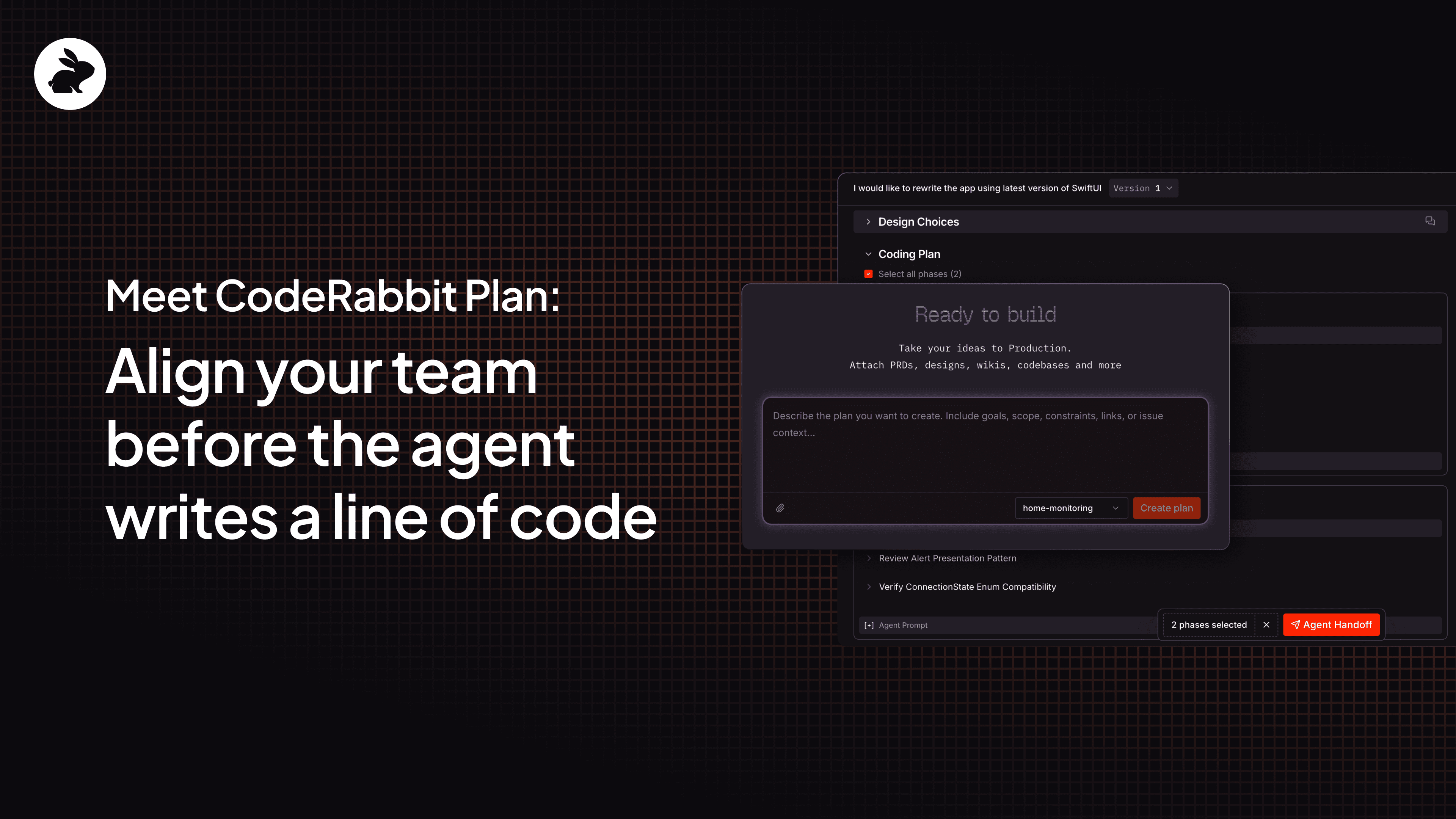
Plan creation now happens through a simple text box. Type a prompt, optionally attach an image and get a full plan back. Apart from that, you can still create plans from issue tracking tools like Linear and Jira.
Core capabilities
Whether you’re building features, fixing issues or prototyping an MVP, CodeRabbit Plan covers you with a few core capabilities:
Researching and creating phased plans and tasks
Generating prompts with context from codebases, knowledge bases, tickets and more
Chat to revision interface
Agent prompts handoff
What a useful coding plan includes
A coding plan turns an idea into a change that someone can inspect before implementation starts. It gives your team a place to agree on the outcome, identify the parts of the codebase involved, and decide how to check the result. The goal is to make important decisions visible while they are still easy to change.
Consider a ticket that says, “Add pagination to the customer list.” Before a coding agent starts, the plan should answer a few practical questions. Which endpoint returns the records? What determines their order? Does the interface need page numbers or a next-page cursor? What should happen when the list is empty, or when a record changes between requests?
A useful plan for that example could read:
Goal: Let users browse the customer list in smaller batches.
Scope: Update the list endpoint and the customer-list interface. Preserve the existing authorization rules and search behavior.
Decisions to confirm: Choose the pagination method, default page size, maximum page size, and stable sort order.
Validation: Cover the first and final pages, an empty result, invalid pagination inputs, and records the current user cannot access.
Review: Check that the implementation follows the agreed behavior and that the tests exercise the important boundaries.
CodeRabbit Plan brings the planning conversation closer to your codebase. Start from an idea or an issue, review the proposed approach with your team, and refine the plan before handing it to a coding agent. Keep the acceptance criteria with the implementation so reviewers can compare the finished change with the original intent.
A plan does not make the resulting code correct by itself. Tests and code review still have a separate job: checking whether the change works, respects the surrounding system, and is ready to merge.
Get started
CodeRabbit Plan is available today. Just go to the CodeRabbit website and give it a try!