CodeRabbit logoCodeRabbit logo
Issue plannerEnterpriseCustomersPricingBlog
Resources
  • Docs
  • Trust Center
  • Contact Us
  • FAQ
  • Whitepapers
Log InGet a free trial
CodeRabbit logoCodeRabbit logo

Products

Pull Request ReviewsIssue plannerIDE ReviewsCLI Reviews

Navigation

About UsFeaturesFAQSystem StatusCareersDPAStartup ProgramVulnerability Disclosure

Resources

BlogDocsChangelogCase StudiesTrust CenterBrand GuidelinesWhitepapers

Contact

SupportSalesPricingPartnerships

By signing up you agree to our Terms of Use and Privacy Policy

discord iconx iconlinkedin iconrss icon
footer-logo shape
Terms of Service Privacy Policy

CodeRabbit Inc © 2026

CodeRabbit logoCodeRabbit logo

Products

Pull Request ReviewsIssue plannerIDE ReviewsCLI Reviews

Navigation

About UsFeaturesFAQSystem StatusCareersDPAStartup ProgramVulnerability Disclosure

Resources

BlogDocsChangelogCase StudiesTrust CenterBrand GuidelinesWhitepapers

Contact

SupportSalesPricingPartnerships

By signing up you agree to our Terms of Use and Privacy Policy

discord iconx iconlinkedin iconrss icon

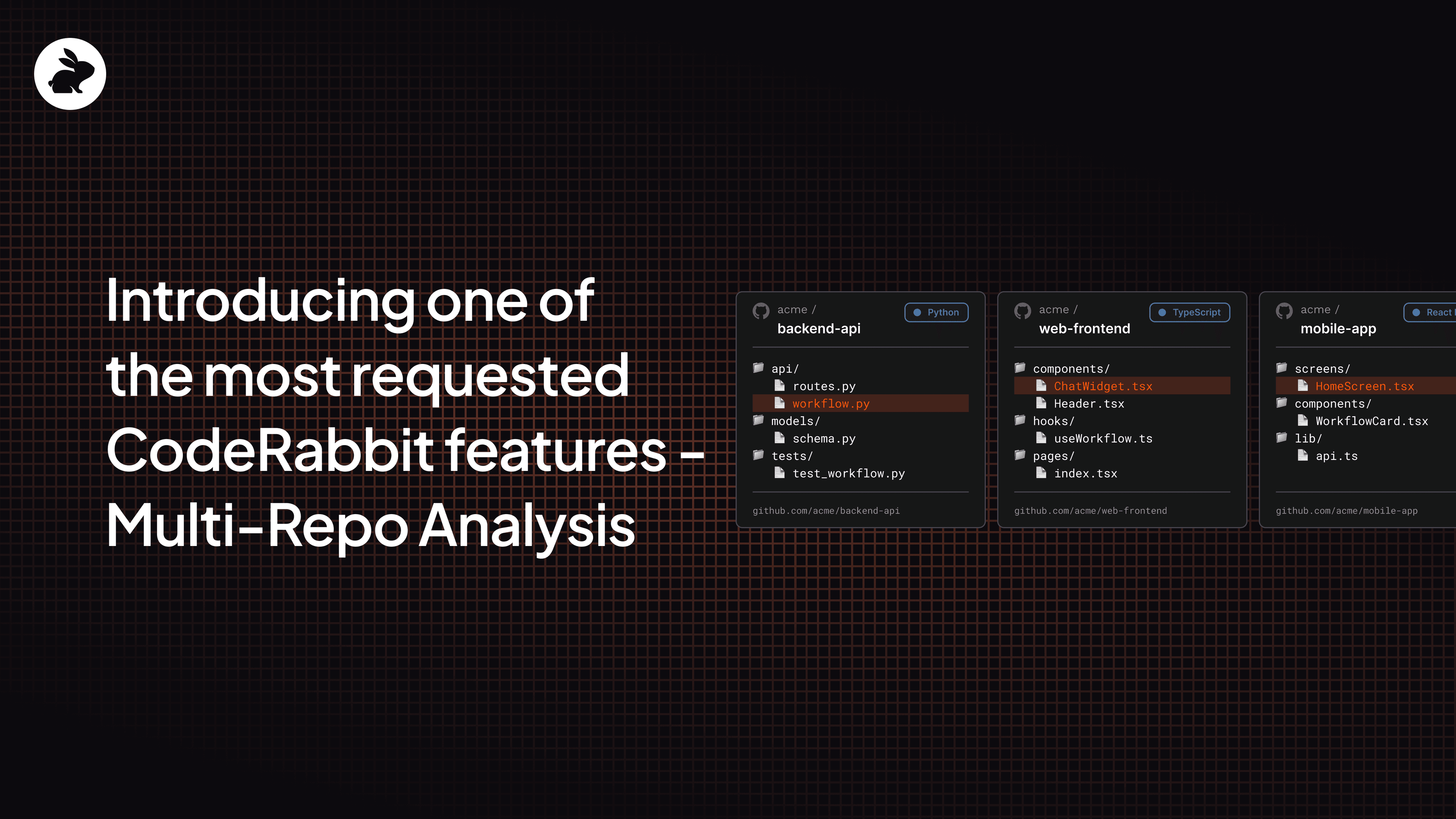
Introducing one of the most requested CodeRabbit features: Multi-Repo Analysis.

by
Konrad Sopala

Konrad Sopala

March 06, 2026

|

3 min read

March 06, 2026

3 min read

  • Introducing Multi-Repo Analysis
  • Setup & configuration
  • See it in action
  • Try it now
Back to blog
Cover image

Share

https://victorious-bubble-f69a016683.media.strapiapp.com/Reddit_feecae8a6d.pnghttps://victorious-bubble-f69a016683.media.strapiapp.com/X_721afca608.pnghttps://victorious-bubble-f69a016683.media.strapiapp.com/Linked_In_a3d8c65f20.png

Cut code review time & bugs by 50%

Most installed AI app on GitHub and GitLab

Free 14-day trial

Get Started

Catch the latest, right in your inbox.

Add us your feed.RSS feed icon
newsletter decoration

Catch the latest, right in your inbox.

Add us your feed.RSS feed icon

Keep reading

Gemini 3.1 Pro for code-related tasks: More focus, higher signal-to-noise

Gemini 3.1 Pro for code-related tasks: More focus, higher signal-to-noise

In practice, developers experience AI code review through the comments it leaves on pull requests: how often it finds real issues, how much noise it produces, and how actionable its feedback is. To an

The one thing devs will still read when they stop reading code

The one thing devs will still read when they stop reading code

Code was never meant to be read. We just had no alternative. Consider a real-world example: a production payments service with layered retry logic, idempotency keys, circuit breakers, feature flags, a

Pre-Merge Checks: Built-in & custom PR rules automatically enforced

Pre-Merge Checks: Built-in & custom PR rules automatically enforced

All development teams claim to have pr standards, which often include requirements like: "Ensure docstrings are added," "Reference the associated issue," and "Avoid logging sensitive information." Def

Faster AI code reviews with NVIDIA Nemotron 3 Super

Faster AI code reviews with NVIDIA Nemotron 3 Super

TL;DR: NVIDIA Nemotron 3 Super delivers high accuracy and faster throughput in CodeRabbit's self-hosted AI code reviews. We are happy to share that CodeRabbit is expanding its support for the NVIDIA N

Get
Started in
2 clicks.

No credit card needed

Your browser does not support the video.
Install in VS Code
Your browser does not support the video.

If you've ever merged a pull request that passed every check, looked clean in review, and then broke a downstream service ten minutes later…you already know the problem.

When your architecture spans multiple repos (microservices, shared libraries, separate frontend and backend packages) a change in one place can silently break things in another. A renamed field in your API response schema? Looks great in the PR, but the three services that parse that response have no idea what's coming.

This is one of the most common pain points we hear from teams running multi-repo setups and it's been one of the most requested features among our customers.

So we built it.

Introducing Multi-Repo Analysis

Multi-Repo analysis is a new CodeRabbit feature available to Pro and Enterprise tier users that let you connect related repositories so that CodeRabbit pulls context from across all of them during code reviews. Think microservices, shared libraries, API contract changes, or any setup where a change in one repo can quietly break another.

When a pull request modifies a shared API, type definition, or database schema, CodeRabbit automatically explores your linked repositories for downstream impact.

Instead of reviewing changes in isolation, you get the full picture before you merge.

Setup & configuration

Before you start using it, there are some platform-specific requirements to go through, to make sure the CodeRabbit bot has read access to all linked repositories:

Platform

Requirement

GitHub

The CodeRabbit GitHub App must be installed on all linked repositories. Inaccessible repositories are skipped, and a warning appears in the review summary.

GitLab

The bot token must have read access. Tokens are typically scoped to the group or instance.

Bitbucket Cloud

The bot token must have read access. Tokens are scoped to the workspace.

Azure DevOps

The PAT must have read access. Tokens are scoped to the organization.

Once that's configured, you can finish the setup in two ways:

  • Through the CodeRabbit web interface

    • Head to Repositories section and select a repository that you would like to add a linked repository to

    • Switch off the Use Organization Settings toggle

    • Go to the Knowledge Base and find the Linked Repositories section.

    • Add a new linked repository with instructions that will guide CodeRabbit during review.

  • Through YAML configuration

    • Add a linked_repositories section under knowledge_base in your .coderabbit.yaml file.
# yaml-language-server: $schema=https://coderabbit.ai/integrations/schema.v2.json
knowledge_base:
  linked_repositories:
    - repository: "myorg/backend-api"
      instructions: "Contains REST API endpoints and database models"

Keep in mind that as of now, each repository configuration supports only one linked repository, though multiple linked repos are planned in the future. For full setup details, check the docs.

See it in action

If you want a hands-on walkthrough, one of our Developer Advocates put together a tutorial that shows Multi-Repo analysis catching real cross-repo issues in a review.

https://youtu.be/BrT4rSHhA10?si=FzPUzcBUgqXdHXmZ

Try it now

A Multi-Repo analysis feature is available today. Connect your repos, open a PR, and let CodeRabbit show you what you've been missing.

Get started