
Small startup, big ambitions: How CodeRabbit helped Dub reach $10M in partner payouts

 CASE STUDY
53.9% acceptance rate for performance and scalability
100-150% more efficient code reviews
Improved code quality
Empowers Dub to flourish as a small team

A five-person team, $10 million in partner payouts, and the AI code reviewer standing watch at every merge
Steven Tey has a rule. It's not written down anywhere, but it shapes how Dub operates every day. You don't move fast and break things when things involve money.
Tey, Dub's CEO and founder, built the San Francisco company on a simple but demanding premise: Link attribution and partner management, the unglamorous plumbing of modern SaaS marketing, could be done better. He left Vercel, where Dub had started as a side project, and turned it into a full company in 2024. Today Dub processes over $2 million in partner payouts each month on behalf of customers like Framer, Superhuman, Perplexity, and, notably, CodeRabbit itself. In December 2025, just six months after launching its partner management product, Dub crossed $10 million in total payouts to creators and affiliates worldwide.
Dub did all of that with a team of five.
When asked whether that growth would have been possible without the AI code-review platform, CodeRabbit, Tey said, "Absolutely not."
"We would not have been able to do that securely, without any issues," he added.
Small team, real stakes
Three of Dub's five employees write code. Tey is one of them, and he often performs the final review before anything touches production. That makes the review layer not just important but load-bearing. There's no safety net of a large engineering org, no dedicated QA team, no rotation of senior reviewers. When Tey pushes code on a Saturday afternoon, it's typically just him.
"We try not to ping folks on weekends," he says. "So it's usually just me, and I basically bounce ideas with AI."
That dynamic, a solo founder shipping features to a payment infrastructure product, is exactly where gaps appear. Not because the engineer is careless, but because the best human reviewers catch different things at different times. Focus wanders. Context gets lost between the feature you just built and the edge case buried three files deep. And with money flowing through the system, the cost of a missed edge case isn't a UI glitch. It's a payout failure, a security vulnerability, a compliance problem.
The CodeRabbit, is, in Tey's words, "the final layer of defense before anything goes into production."
No margin for error
Dub launched its Partners product — a full affiliate and referral management platform — in 2025, and CodeRabbit was woven into its development from day one. The product handles the kind of operations that demand precision: commission tracking, payout processing, tax compliance for US-based partners (W-9 collection, 1099-NEC filing), and bulk payouts to tens of thousands of partners in a single transaction.
This is software where an off-by-one error in a payout calculation isn't a minor bug. It's a financial discrepancy that could affect people’s livelihood.
Dub's approach to managing risk at this scale starts with scoping. Rather than shipping sprawling features all at once, the team builds v1 releases, ships, learns, and follows with v2. CodeRabbit reinforced that discipline at the code level.
"Code cleanliness is a big thing for us, for us to scale," Tey says. "CodeRabbit is pretty good at making sure that the way we write code is efficient and without any security issues."
The entire codebase is open source, visible at github.com/dubinc/dub, where every CodeRabbit review is part of the public record. The repo has accumulated roughly 24,000 commits.
The weekend shift
There's a Slack channel at Dub called #papercuts. It's where small, nagging issues go to be catalogued — the kind of things that are annoying but not urgent, that get displaced by higher-priority work and quietly accumulate. On weekends, Tey picks some of them up.
"I ask AI to figure out the best solution," he says. "And it does come up with pretty decent solutions sometimes, stuff that I wouldn't have thought about."
What he describes is something that has become increasingly common. The weekend has become a different kind of working session. Not a crunch, but an exploration. AI tools make it easier to get traction on a problem without needing to wait for the rest of the team to assemble. You can prototype a fix, have CodeRabbit review the resulting PR, and merge something solid before Monday, all without ever pinging anyone.
Tey's AI setup is deliberately simple: Cursor for code generation, CodeRabbit for review. The two tools arrived at Dub at roughly the same time, and Tey sees them as complementary. Cursor generates and CodeRabbit evaluates. "Both came hand in hand, which is good timing."
What reliability actually means
When describing CodeRabbit, these are the words Tey returns to repeatedly in conversation, “innovative” and “reliable.”
"It's been very reliable so far," he says of CodeRabbit.
"It's incredibly critical that we have a reliable partner in that space," he said. "CodeRabbit has always been very solid."
For a team at Dub's scale, reliability is non-negotiable. A code review tool that occasionally misses things, or produces noisy feedback that engineers learn to ignore, or behaves inconsistently across PRs erodes trust. And an untrusted review tool is barely better than no review tool, because it creates false confidence.
Before settling on CodeRabbit, Tey evaluated other code-review tools. "Tried it out. Did not fully get convinced," he said.
The adoption path itself was frictionless. "We basically just installed the CodeRabbit integration on GitHub and were off to the races," Tey says.
High acceptance rate = Devs moving fast
Across Dub’s use of CodeRabbit, the platform achieved an overall acceptance rate of 48.3%, meaning nearly half of CodeRabbit’s suggestions were accepted by developers.
Acceptance was especially strong on high-value findings, including 42.1% for critical issues and 40.9% for major issues, with 44.1% acceptance for minor issues.
The impact also cut across multiple review categories. Acceptance rates reached:
- 46.2% for functional correctness
- 45.9% for data integrity and integration
- 53.9% for performance and scalability
- 47.1% for stability and availability
Together, those numbers suggest that CodeRabbit was not only catching superficial issues, but contributing across the range of concerns engineering teams have to manage in production systems.
Merge with confidence
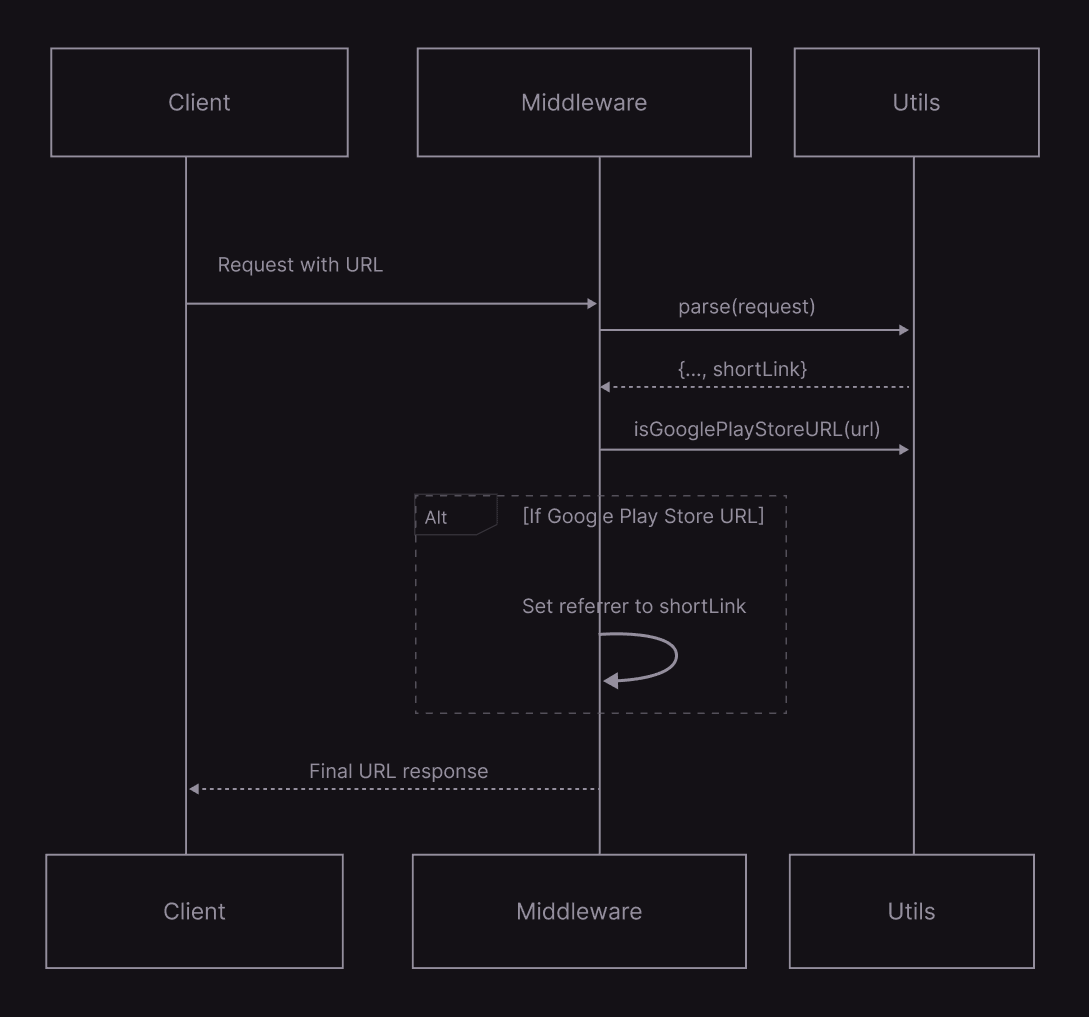
PR #2714 is a representative example of the Dub workflow in action. Tey recently opened a pull request titled "Handle Google Play Store Referrer API." It’s a feature that ensures Dub's attribution tracking works correctly when a user arrives at an app via the Play Store, where referrer parameters need to be embedded differently than in a standard web redirect. The PR touched four files across Dub's middleware layer: the getFinalUrl function was refactored, a new utility isGooglePlayStoreUrl was created, the parse function was extended to return a shortLink property, and new test cases were added to cover the redirect scenarios.
CodeRabbit reviewed the PR automatically, generated a full walkthrough and a sequence diagram mapping the new control flow — Client → Middleware → Utils, with a branch for the Play Store case and rated the implementation clean. Before merging, Tey typed @coderabbitai full review to trigger a final pass. The PR was approved and merged the same day.
What's notable here is what made the absence of drama possible. A PR touching Dub's core attribution middleware, handling a mobile edge case where a missed referrer parameter could silently break commission tracking for partner links running through this route, merged cleanly and confidently the same day it was opened. That's not luck. It's what happens when a reliable review layer is baked into the process from the first commit. Tey could type @coderabbitai full review, get a clear signal, and hit merge without needing a second engineer in the room, and without the low-grade anxiety that comes with self-reviewing code you wrote yourself.
The efficiency math
Tey said his team is 100% to 150% more efficient when it comes to code reviews. Without CodeRabbit, he said, reviewing a PR that currently takes him one pass would require two to three times the effort, or more.
What that math means in practice. The small engineering team at Dub can maintain a pace that, in a prior era, would have required a considerably larger group. Whether that translates to two additional headcount or five is impossible to say exactly. But for a startup managing its burn rate while competing with better-resourced incumbents, the compounded effect of that efficiency is significant.
"We move way faster than our competitors," Tey said, "thanks to CodeRabbit."
He frames the pitch to other founders in direct terms: "If you're building a SaaS product in today's day and age and you're not using a code-review agent like CodeRabbit, you're wasting your team's time. They would need to manually review a lot of those changes, and if you extrapolate that to how much you're paying developers per hour, it is a pretty big cost that you need to be aware of."
CodeRabbit = Faster reviews and confident deployments
Before CodeRabbit
- PRs required manual, file-by-file review — a process Tey describes as taking two to three times longer than it does today
- Engineers working solo, especially on weekends, had no reliable sounding board before shipping to production
- Reviewing AI-generated code from Cursor meant added scrutiny with no automated safety net to catch what slipped through
After CodeRabbit
- A single @coderabbitai full review command replaces hours of manual review, with a walkthrough, sequence diagrams, and line-by-line feedback generated automatically
- Tey can merge sensitive middleware code — touching payment processing and attribution logic — solo and with confidence, without a second engineer in the room
- The team ships at a pace Tey estimates is 100% to 150% more efficient, moving faster than competitors while handling real financial transactions without breakage
Results: Faster shipping, cleaner code, $10M in payouts
100–150% more efficient code reviews
Without CodeRabbit, Tey estimates reviews would take two to three times as long, accounting for the manual, file-by-file process he relied on before. With it, the team's three engineers maintain a shipping pace that would be difficult to sustain at twice the headcount without AI review in the loop. "If I were to put a number," Tey said, "probably 100% more efficient when it comes to code reviews, if not 150%."
$10 million in payouts shipped securely in six months
The most concrete measure of what CodeRabbit made possible is the number Dub published in December 2025: $10 million in partner payouts processed in the first six months after launching its partners product. That product, handling commission tracking, bulk payouts, and tax compliance for thousands of partners worldwide, was built hand in hand with CodeRabbit reviewing every PR. Tey is direct about the connection: "We wouldn't have been able to do that securely, without any issues, without the help of CodeRabbit."
A solo founder who can ship on a Saturday and sleep Sunday
Perhaps the least quantifiable result is also the most telling. Tey regularly pushes code on weekends, alone, on a payment infrastructure product where mistakes have real financial consequences. CodeRabbit is what makes that sustainable, not just efficient, but psychologically viable. "CodeRabbit is definitely that final layer of defense before anything goes into production," he said. For a founder who is also an engineer, that's not a feature. It's peace of mind.

San Francisco, California
https://dub.coIndustry
Affiliate and referral management software
Challenge
Dub needed to move fast on a payment infrastructure product without the engineering headcount to match its ambitions and without the luxury of breaking things.


