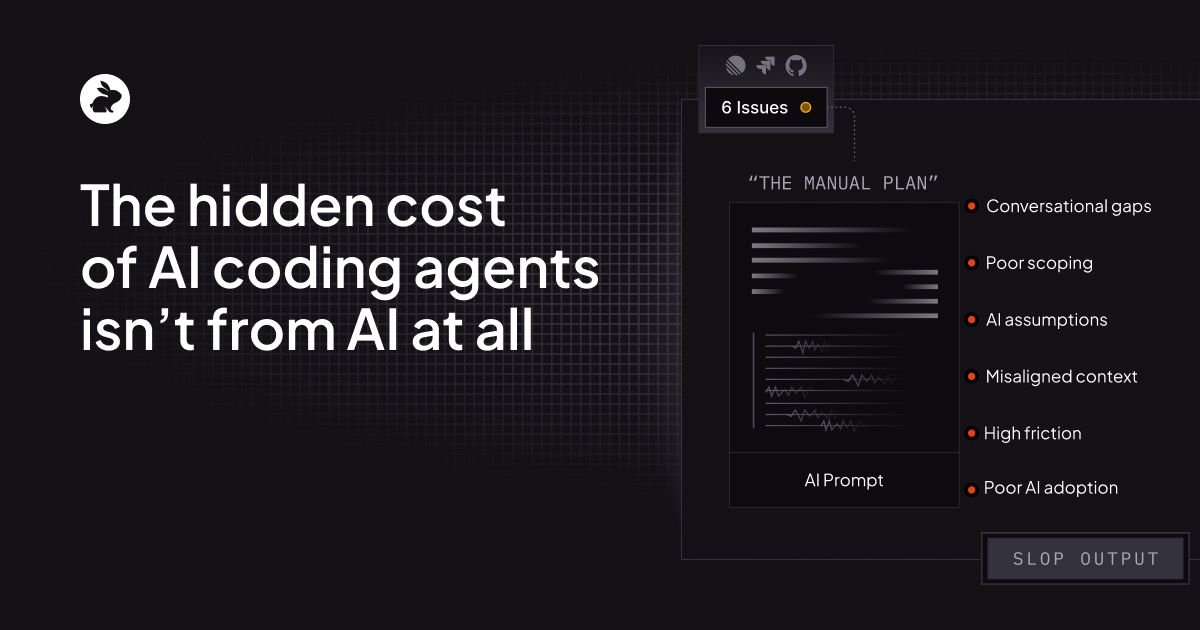
TL;DR: The real cost of AI agents isn’t tokens or tools; it’s misalignment that shows up as rework, slop, and slowed teams.
The conversation everyone is having (and why it misses the point)
Most conversations about AI coding agents sound like a fantasy football draft.
Which model is better at autonomous coding?
Which one topped the benchmarks this week?
Which one “reasons” better?
These debates take over blog posts, launch threads, and Slack channels everywhere. Devs on Twitter compare outputs line by line, argue over microscopic differences in reasoning quality, and swap models like they’re changing themes. Surely, this one will fix it.
But for most teams, these differences aren’t what determine whether AI actually helps them ship faster.
When AI-generated code goes sideways, it’s not typically because the model wasn’t smart enough. It’s because the agent had no idea what you really wanted. The code can be perfectly valid, logically sound, and honestly impressive… and still be completely wrong for your team, your codebase, or your product.
That gap shows up as rework. Or repeated prompt tweaks. Or long review threads explaining intent after the fact. Or worse, developers spending more time correcting AI output than they would have spent writing the code themselves.
Turns out, we’ve all been optimizing for model quality but forgot to measure drift.
The most important factor in your success with AI agents isn’t which model you picked but how you’re adopting it as a team. Because turns out misalignment is the quiet, compounding problem that slowly eats your time while everyone’s busy arguing about benchmarks.
Speed exposed an existing problem
Before AI agents, misalignment was annoying… but survivable.
Writing code took time. If requirements were fuzzy or assumptions were wrong, you usually discovered it halfway through writing the code or maybe during review. The feedback loop was slow, but forgiving. Humans hesitated, they asked questions, and then course-corrected as they went.
But now? When an agent can generate hundreds or thousands of lines of code in seconds, it doesn’t stop to check whether your requirements were vague. It doesn’t ask clarifying questions. It doesn’t say, “Hey, this seems underspecified.” It just… goes. Confidently. In whatever direction it decides you likely intended.
What used to be a small misunderstanding becomes a massive diff to review. What used to be a quick clarification turns into a full rewrite. And suddenly you’re staring at a PR thinking, “Technically, this is correct. Practically, it’s unusable.”
This is why teams feel like AI made them both faster and slower.
Execution is instant. Correction is not. The faster the agent, the more expensive unclear intent becomes.
The overlooked tax: AI rework
When AI output is bad, it rarely looks like failure. Instead, it looks like iteration.
You run the agent. The result is close but not quite right. So, you tweak the prompt. Then, you tweak it again. You add more context. You clarify one edge case. You re-run the agent. And then you repeat. That’s progress these days.
Each cycle feels small. But stack enough of them together and suddenly you’ve spent an hour rewriting prompts, reviewing generated code, and explaining intent without actually moving the work forward.
It’s also a tax that can hit teams unevenly. Not everyone is an expert at writing prompts for coding agents. A few people on your team might be great at it but no teams are stacked entirely with prompting experts. Some might be prompting efficiently and effectively while others waste hours trying to rework things after the fact.
Rework can show up as:
Long PR threads clarifying decisions that were never made explicitly
Code that technically passes tests but violates team conventions
Engineers quietly thinking, “I could’ve just written this myself” and deciding not to use AI the next time, reducing AI adoption across teams.
The worse the alignment, the higher the tax. Every missing assumption gets paid for in re-prompts, reviews, and rewrites. Or worse, it leads to bugs and downtime in production. And unlike a failed build or a flaky test, this cost doesn’t always trip alarms. It just eats time quietly.
Misalignment doesn’t stay contained. It compounds.
Misalignment early in the workflow doesn’t just cause one problem: it causes a chain reaction.
When intent isn’t clear up front, the agent fills in the gaps. That leads to code that’s almost right, close enough to look reasonable, but wrong enough to create work everywhere else. Suddenly, reviews are harder, tests are more complicated, and you’re having to rewrite half the PR yourself.
What should’ve been a small clarification becomes a long review thread. What should’ve been a quick decision becomes a follow-up meeting. And what should’ve been a clean change becomes a series of patches trying to reconcile what the code does with what the team meant.
Misalignment discovered early is cheap. Misalignment discovered late is expensive. Once code exists, every correction has a blast radius. You’re not just fixing intent, you’re undoing structure, refactoring assumptions, and explaining decisions that were never made explicitly by a human in the first place.
AI doesn’t create this problem. It accelerates a problem that’s inherent in creating software: unclear intent and unaligned expectations. In the past, this was solved by a quick conversation to clarify. But because agents move so fast, they push misalignment downstream at full speed. By the time a human steps in, the cost has already multiplied. You’re no longer deciding what to build, you’re negotiating with code that already exists.
The real solution: Collaborative planning
Collaborative planning moves the hardest decisions to the moment when they’re still cheap: before code exists. You need to tackle them before agents start guessing and before assumptions get baked into hundreds or even thousands of lines of output.
Instead of one person silently deciding what “good” looks like and encoding it into a prompt or worse, leaving it to the agent, teams agree on it upfront. Scope is explicit, assumptions are visible, and success criteria are shared. Intent stops living in someone’s head and starts living in an artifact the whole team can review.
This changes the whole process. Agents stop improvising, reviews get lighter, and rework drops dramatically.
Collaborative planning isn’t about slowing teams down or adding process. It’s about preventing the kind of misalignment that quietly drains time later. A few minutes of alignment upfront can save hours of cleanup downstream.
Why we built CodeRabbit Issue Planner
We didn’t wake up one day and decide to get into planning. We followed the failures.For years, CodeRabbit has lived where problems from AI coding agents show up most clearly: in reviews. We’ve seen the same patterns repeat across teams, languages, and stacks, especially as AI agents became part of everyday workflows.
The issues weren’t subtle.
We saw generated code that technically worked but missed the point, long PR threads explaining decisions no one remembered making, and repeated fixes for assumptions that should’ve been surfaced earlier. In fact, our recent study found that they show up 1.7 times more than in human written code.
Again and again, the same conclusion kept surfacing: the problem didn’t start in the code. It started before the code existed.
Reviewing output was no longer enough. If we wanted to reduce rework, improve quality, and actually help teams move faster with AI, we had to move upstream, without abandoning what made review effective in the first place. Collaborative planning gives teams a way to align on intent before agents start executing, so reviews catch fewer surprises and you can actually ship faster.
How CodeRabbit Issue Planner works
CodeRabbit Issue Planner connects directly to your issue tracker (we currently support Linear, Jira, and GitHub Issues) and helps teams plan before any code is written.
When an issue is created, CodeRabbit’s context engine automatically builds a Coding Plan. It outlines how the work should be approached, identifies which parts of the codebase are likely to change, and breaks complex requirements into clear phases and tasks that an AI coding agent can execute.
That plan is enriched with real context: past issues and PRs, organizational knowledge from tools like Notion or Confluence, and relevant details pulled directly from your codebase.
The result is a structured, editable plan and a high-quality prompt package, ready to run in your IDE or via CLI tools.
Before anything is generated, your team can review the plan, refine assumptions, and iterate on the prompt together. Every version is saved, so decisions and intent don’t get lost over time.
When you’re ready, CodeRabbit hands the finalized prompt off to the coding agent of your choice. Then, generation starts with clarity, not guesswork.
The outcome: faster planning, better prompts, fewer misunderstandings, and a development process aligned around shared intent from the very beginning.
Measure what actually matters
It’s easy to focus on more talked about parts of AI adoption. That’s why so many teams focus on things like: model quality, speed, and how impressive the output looks in isolation.
But the teams that succeed with AI aren’t the ones chasing the agent with the best benchmark score. They’re the ones refining their processes to reduce rework, minimize confusion, and keep alignment cheap by planning effectively together.
In the AI era, coding is becoming easier. The real work is shifting left towards planning and, at CodeRabbit, we’re here to help.
Learn more and try Issue Planner today!