
Langflow boosts merge confidence by 50% with CodeRabbit

 CASE STUDY
Detects Issues in AI-Generated Code
Consistency Across Large, Dynamic Codebases
50% Higher Merge Confidence
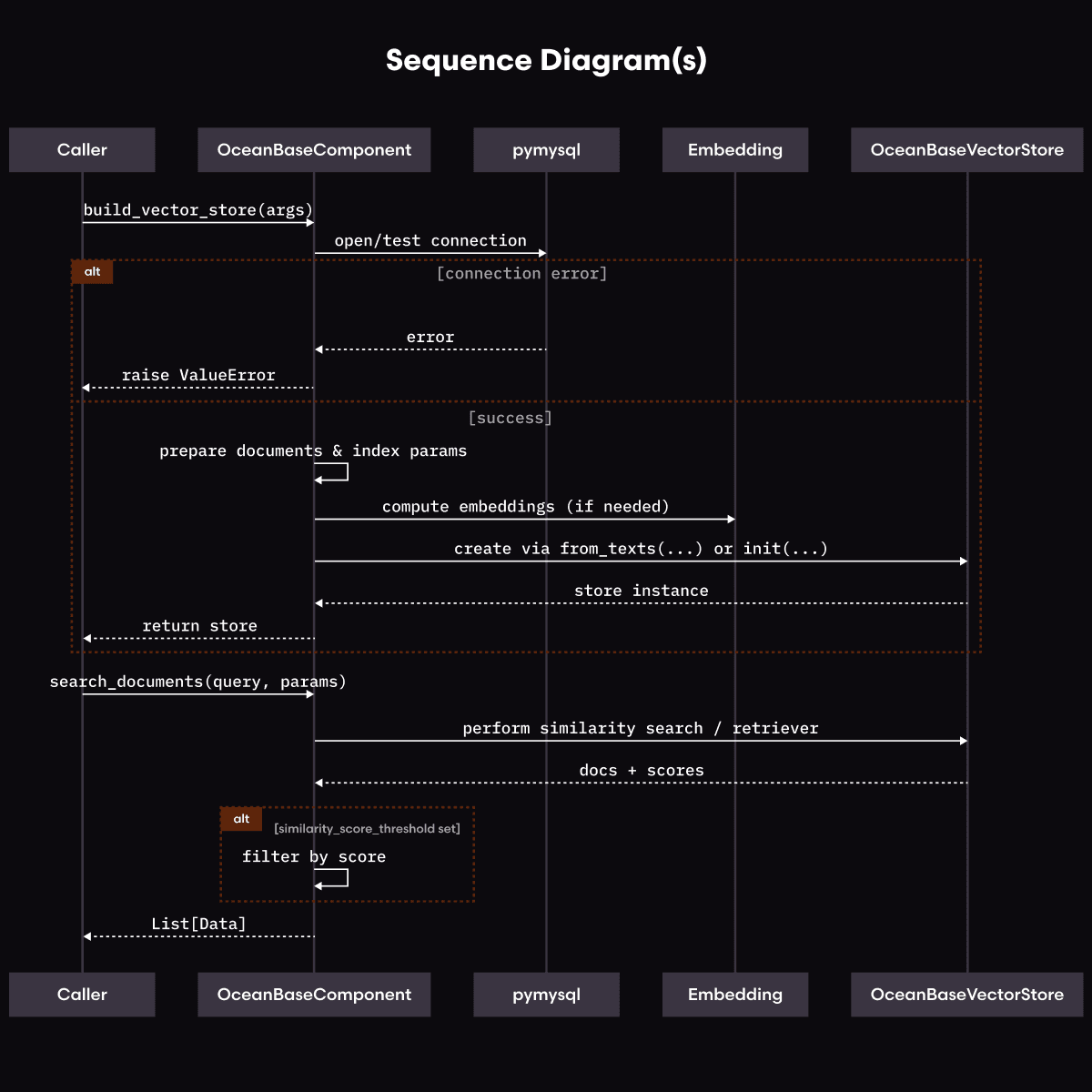
Automatic Sequence Diagrams

For Gabriel Almeida, the technical founder of Langflow, managing code quality is critical, as thousands of developers worldwide rely on his open-source platform to build AI applications. Langflow, a no-code environment for building AI projects without sacrificing programming power, has become one of the most significant AI-focused open source projects ever created, boasting over 100,000 GitHub stars and ranking among the top repositories on GitHub.
The team processes over 100 pull requests per week, with Gabriel historically reviewing the majority of PRs himself due to his comprehensive understanding of the codebase. This intensive review process created a bottleneck that limited both his ability to focus on high-value development work and the team’s ability to move quickly.
Gabriel discovered CodeRabbit after he found a video about it on YouTube and was immediately intrigued. After experimenting with the tool and demonstrating it to his team, he found that CodeRabbit’s free access for open source projects made it an ideal solution for Langflow’s needs.
Challenge: Scaling code reviews across a high-velocity open source project
Before CodeRabbit, Langflow’s development process created significant bottlenecks. Gabriel personally reviewed most of the team’s 100+ weekly pull requests, but even his comprehensive oversight faced limitations when managing a project of this scale.
The founder bottleneck limited team velocity: As a technical founder who built a backend, Gabriel felt responsible for reviewing virtually every PR. “I did a lot more than just program. And one of the things I did most of the time was managing the repository, managing the community, and so on, Gabriel explained. “I had to review all PRs, essentially.” This created an unsustainable workload where one person became the critical path for all code changes.
Limited holistic codebase understanding across team members: While Gabriel understood the entire codebase, other team members often lacked the broader context needed for effective code review. “A lot of people had only worked on certain parts of the project and didn’t have a holistic view,” Gabriel noted. This knowledge gap meant that team members couldn’t confidently review code outside their specific areas of expertise.
Previously, trying inadequate AI-assisted review tools: The team had experimented with GitHub Copilot for review but found it to be insufficient for collaborative PRs. “Copilot… only reviewed code. It was not what we were looking for because I can just ask ChatGPT to review the code, “ Gabriel shared. In contrast, CodeRabbit enables PR conversations, sequence diagrams, and commit-ready suggestions, making it easier for teammates who don’t know the whole codebase to participate effectively.
50%
increase in merge confidence
100,000+
GitHub stars
100+
PRs/week
Why Langflow loves CodeRabbit
Superior error detection beyond other AI tools
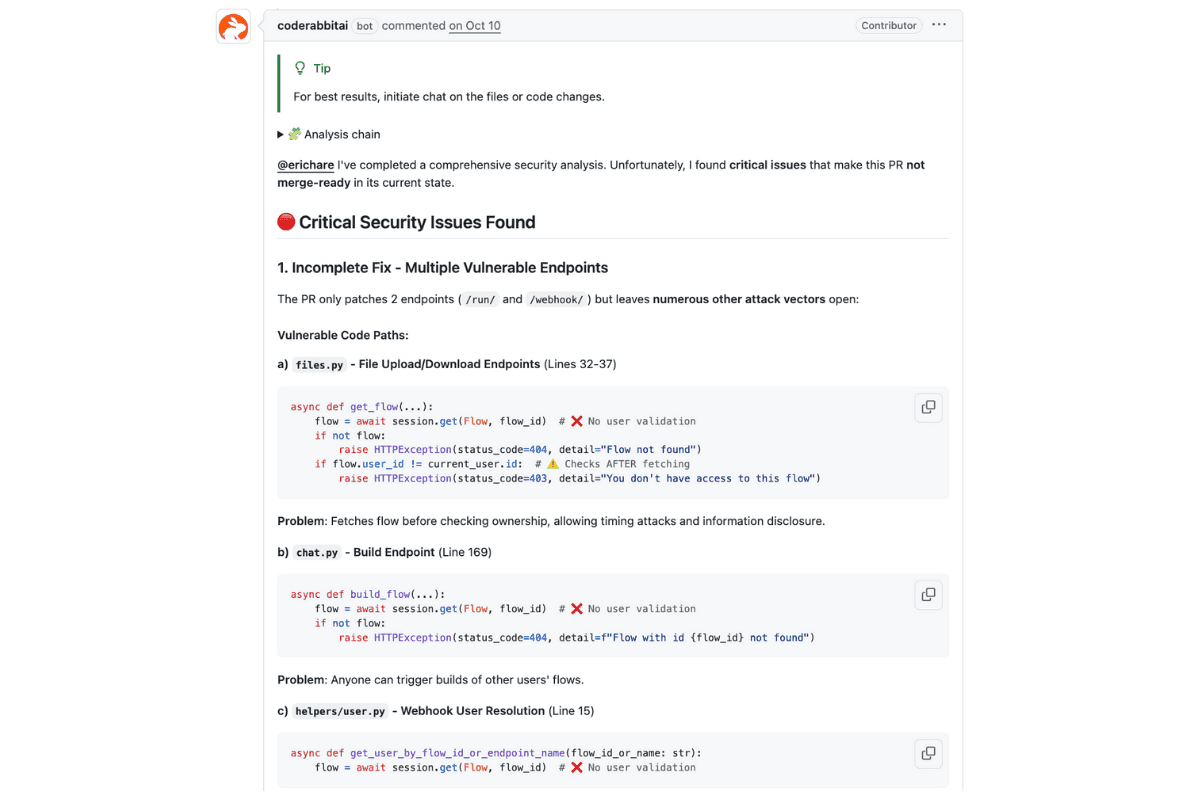
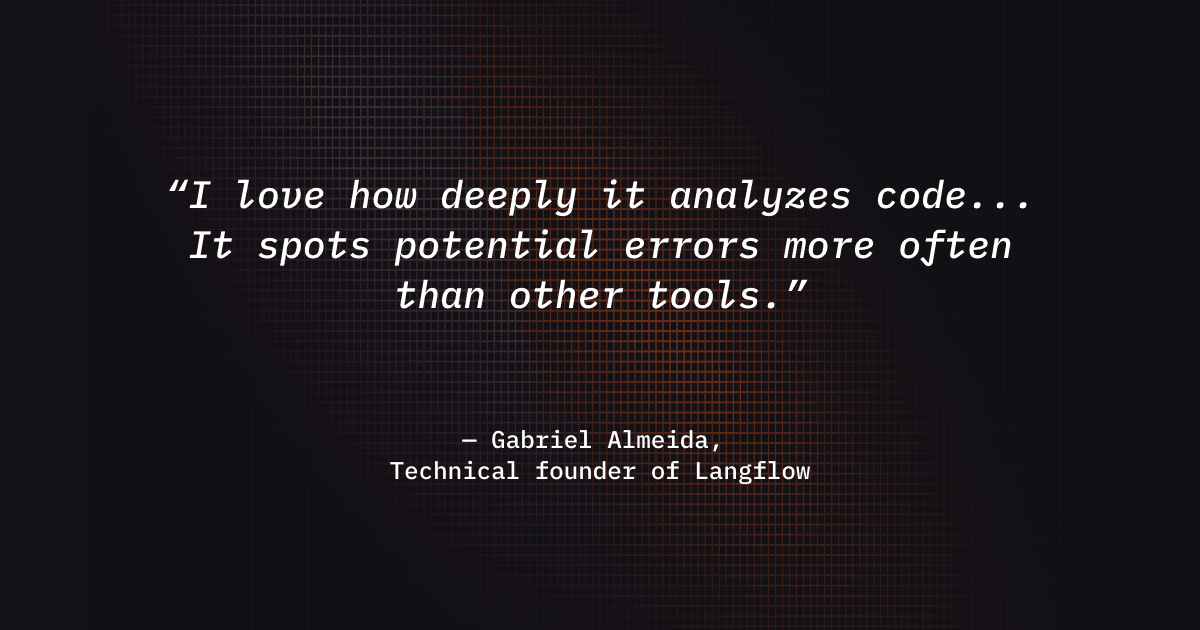
One key reason Langflow loves CodeRabbit is its ability to identify issues that other AI tools miss. Even in a codebase where much of the code is AI-generated, CodeRabbit consistently finds problems that escape human detection. “I love how deeply it analyzes code, it spots potential errors more often than other tools,” Gabriel said, “We use AI a lot; much of the code is AI-written, yet it still misses issues that CodeRabbit catches," Gabriel shared.
Check out Langflow PR
Interactive review process with contextual understanding
CodeRabbit’s ability to engage in contextual conversations within PRs transformed how the team approaches code reviews. Unlike their previous tools, CodeRabbit allows team members to ask questions and get detailed explanations about code changes.
"You can respond in the same thread, and it will take a look at what you're saying in context," Gabriel explained. This interactive capability allows team members to gain deeper insights into PRs, even when they lack comprehensive knowledge of the affected code areas.
Comprehensive diagrams & holistic code analysis
The sequence diagrams and overall analysis of CodeRabbit help team members understand the broader impact of code changes. “With questions that they can ask quickly in the middle of the PR or the diagrams that it generates. Which are very useful,” Gabriel noted. These visual aids bridge the knowledge gap between team members with different levels of codebase familiarity.
Committable suggestions for rapid improvements
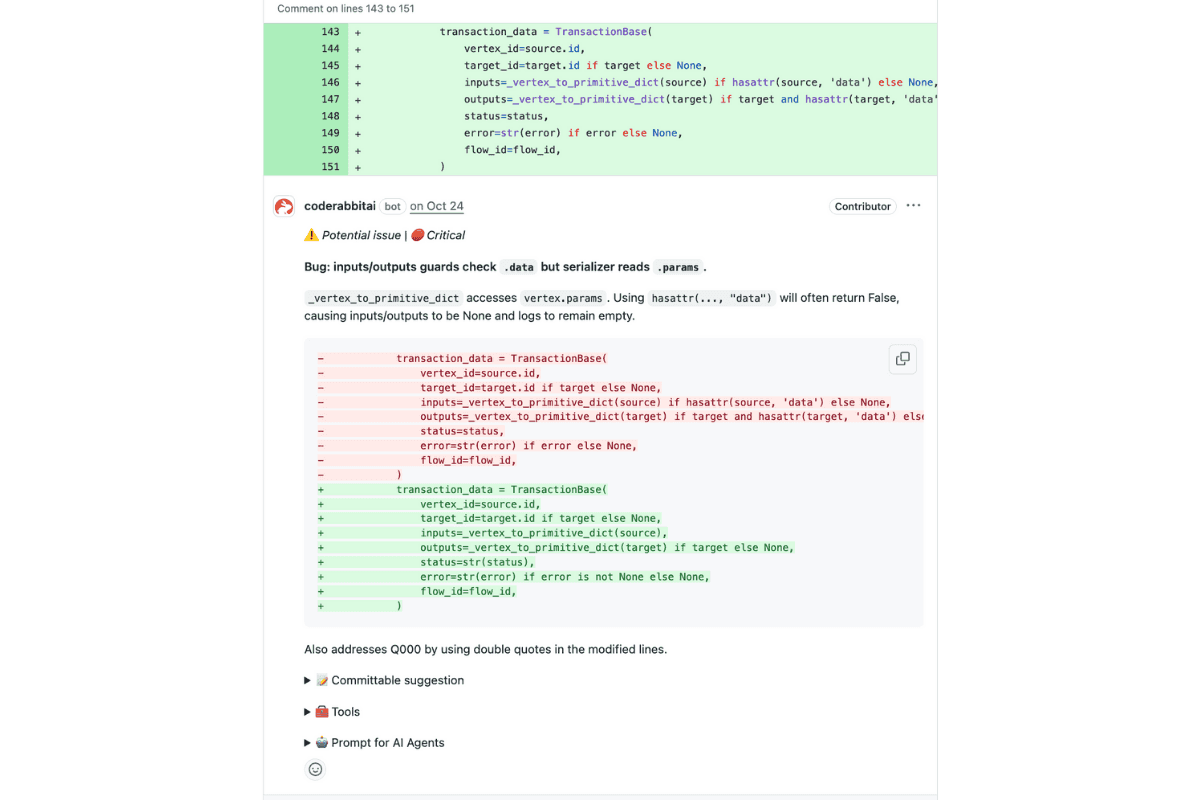
CodeRabbit’s ability to provide directly committable suggestions significantly speeds up the review process. Gabriel demonstrated this value with an example: “I added a condition that was poorly written and CodeRabbit was able to flag the condition and suggested that I should write it differently.” This proactive identification prevents issues that could remain undetected for extended periods.
Check out Langflow PR
Results: 50% increase in merge confidence & distributed review responsibility
Once CodeRabbit was fully integrated into their workflow, Langflow saw significant improvements across their development process: 50% increase in merge confidence and elevated PR readiness CodeRabbit helps ensure PRs are more thoroughly vetted before human review and increased confidence in merging by 50%. “I think the goal when you’re delivering a PR is to have it as ready as it can be for merging,” Gabriel explained. “With CodeRabbit, the PR is close to being ready before someone does the code review.” This improved readiness reduces back-and-forth cycles and helps developers maintain focus: “It gives developers clear next steps, so they don’t forget where they were,” Gabriel said. This reduces context switching by keeping them focused on the task at hand.
Distributed review capability across the team
CodeRabbit enables team members to review code outside their immediate areas of expertise effectively. “How can they connect all the dots without knowing everything? And using the diagram and talking to CodeRabbit in the PR gives them insights into what bugs pushing code might cause,“ Gabriel shared. This distribution of review responsibility has tangible benefits: “Because there are more people reviewing PRs quicker, I can spend time doing other work and just not reviewing PRs all the time.”
Enhanced the founder's focus
By reducing Gabriel's review burden, CodeRabbit enables him to focus on higher-value activities. Since Gabriel is also one of the most valuable developers on the team, that allows him to work on more critical tasks. “This type of task should be distributed across the team so everyone, including me, can make better decisions," he noted. Now, he can focus on strategic development while maintaining oversight through CodeRabbit's analysis.
CodeRabbit = Scalable quality for high-velocity open source development
Before CodeRabbit
- Founder bottleneck reviewing 100+ PRs/week
- Bugs slipped through in AI-generated code
- Team lacked holistic codebase understanding
- Copilot-style tools couldn’t support contextual PR review
After CodeRabbit
- 50% higher merge confidence
- PRs arrive nearly merge-ready
- Catches issues in AI-generated code that humans miss
- Team can review outside their expertise; founder no longer bottleneck
For Gabriel and the Langflow team, CodeRabbit isn’t just another development tool; it’s become essential infrastructure for scaling code quality across rapidly growing open source projects. “CodeRabbit significantly raises our team’s knowledge across big projects like Langflow,” Gabriel explained.
CodeRabbit stands out for Langflow’s team because of its unique ability to catch issues that other AI tools miss while providing the contextual understanding needed for effective distributed code reviews. This combination ensures that Langflow continues to maintain high code quality standards while enabling the velocity required for a project with over 100,000 GitHub stars.
Industry
Open source AI application development
Challenge
Managing code review quality across a growing open source project with 100,000+ GitHub stars while maintaining founder oversight and enabling team-wide code understanding.


