
How Common App cut code review time by 35% & found more bugs

 CASE STUDY
Flags hard-to-catch logic & race conditions
AI summaries & automatic sequence diagrams
Fewer manual reviewers per PR
Learns from developer feedback over time

Common App, a non-profit that facilitates U.S. college applications from more than one million students to over 1,100 institutions, regularly handles highly sensitive student data submitted under tight deadlines. That means CommonApp has to ensure its platform functions flawlessly and that data is handled securely. Any disruption to the millions of students using CommonApp each year wouldn’t just result in a flood of support tickets—it could impact thousands of colleges or even be a national news story.
With a team of 20 developers working on the application's front-end and back-end, Amit Kumar, Common App’s Principal Software Developer, faced challenges with its manual code review process, which slowed progress and increased the risk of overlooked bugs. Even using SonarQube, SonarSource’s security and static analysis tool, wasn’t enough. It only looked for security issues based on static rules and didn’t flag more complex bugs that could cause problems, just as students were submitting their applications.
Enter CodeRabbit, an AI-driven tool designed to automate code reviews. After hearing about CodeRabbit on Reddit, Common App tried it out and saw substantial speed and code quality improvements. This allows developers to focus on building new features and ensuring the security of student data.
Challenge: Complex code reviews on a high-stakes application
Before adopting CodeRabbit, Common App had a code-review bottleneck. Their process was manual, requiring two developers to review each pull request while carefully following an internal checklist of potential issues to look for. The Common App process was created to ensure nothing slipped through. That often led to frustrating delays and was resource-intensive.
Amit described the process as tedious: “It was long, manual, and error-prone. We would have two reviewers per pull request, and even with a detailed checklist, we were still missing some critical details.”
The complexity of the codebase made matters worse:
Mixed tech stack challenges:
Working with legacy applications and technologies like .NET Core, Node.js, Angular, and Python made it complicated for newer developers to grasp the full impact of changes. “Over time, we have modernized some parts of our application, but it's very complex,” Amit explained. “Most of our team is newer, so they don't know the whole system. It's hard for them to envision what impact a code change could have.”
Large PR workload:
The added complexity of their tech meant reviewers had to try to understand how these different pieces fit together with each Pull Request, slowing the development cycle. Reviewing PRs felt like piecing together a complex puzzle, meaning minor things were often overlooked. With 10 to 15 pull requests to review every week, reviewers sometimes developed PR fatigue, which increased the chances they might miss something. “When you’re so focused on the big picture, you could overlook small problems,” shared Amit.
High-stakes bug and security concerns:
Common App handles extremely sensitive Personally Identifiable Information (PII) for millions of students, making data security a top priority. While tools like SonarQube caught basic issues with static rules, they couldn't detect subtle problems that could expose student data or cause issues that could delay student applications. “The focus of SonarQube was just on the security aspect, so it was just covering one angle,” said Amit.
35%
Decrease in code review time
2:1
Manual reviewers required per pull request
1M+
Students supported on the platform
1,100+
Institutions served
Why Common App loves CodeRabbit
Instant AI summaries & sequence diagrams
One of the top features Common App appreciates about CodeRabbit is the AI-generated summaries and sequence diagrams. “I love the sequence diagrams. They make the whole pull request so easy to understand,” Amit shared.
Flags critical but hard-to-catch issues
CodeRabbit's AI-powered reviews highlighted issues that would have otherwise been missed, such as subtle but critical errors. "Recently, CodeRabbit flagged a race condition that SonarQube missed," Amit shared. "Race conditions are difficult to catch manually, but CodeRabbit picked it up immediately." It also flagged code quality issues, such as a query written in a way that excluded some of the rows. “We wanted to exclude that part, but CodeRabbit flagged that in the long run it would make sense to rewrite it so it was futureproofed,” Amit shared. CodeRabbit's findings show that these issues have significantly improved over Common App’s previous tools, which would have missed them. “CodeRabbit provides a broader review,” he shared.
Faster, more efficient workflows
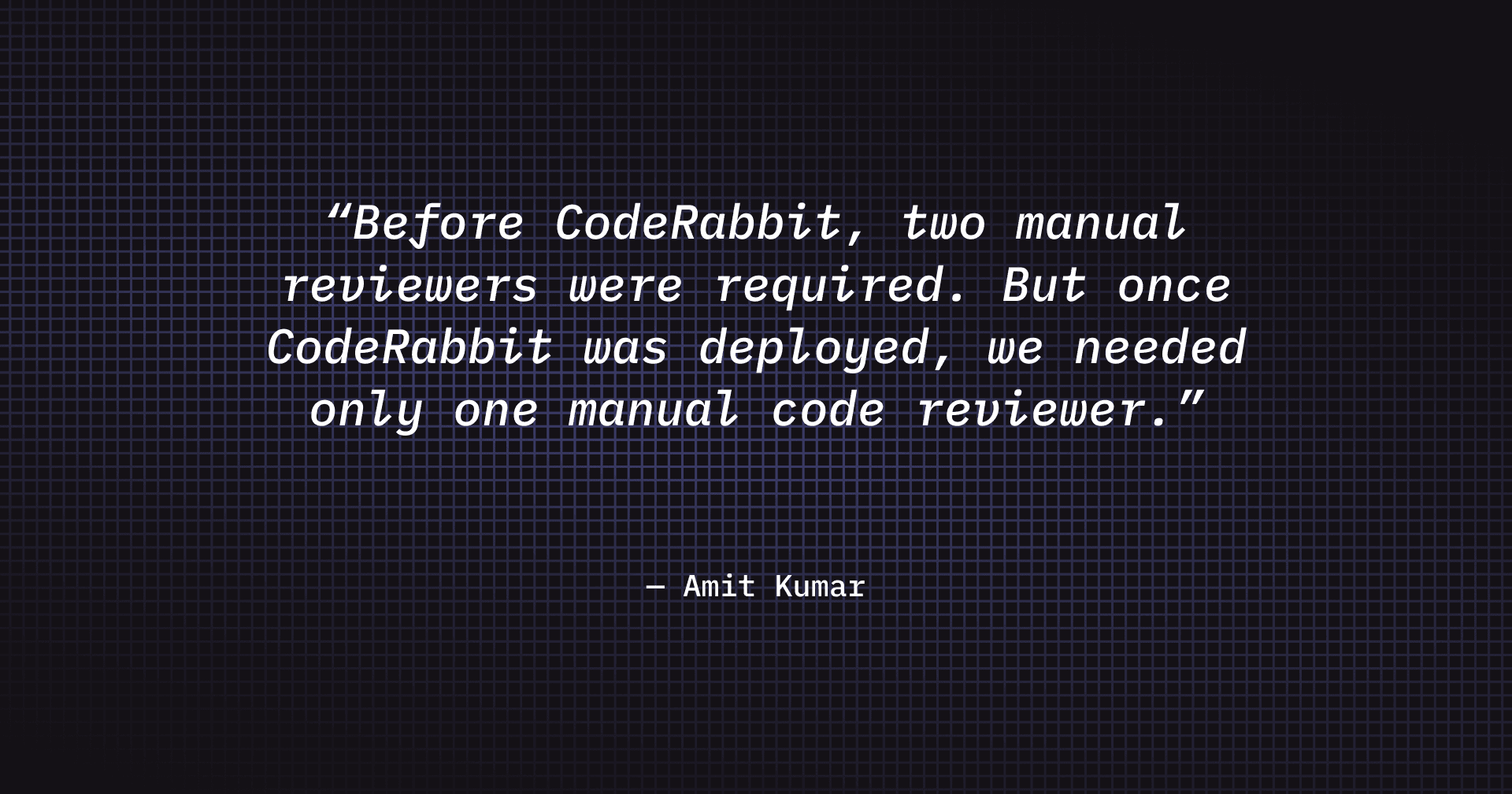
After implementing CodeRabbit, Common App reduced code review time by up to 35%. This was because CodeRabbit flagged so many critical issues that Common App was able to reduce the number of people who reviewed their PRs. “Before CodeRabbit, two manual reviewers were required. But once CodeRabbit was deployed, we needed only one manual code reviewer,” explained Amit. Then, with CodeRabbit flagging most bugs and security concerns, that single reviewer mostly needed to focus on the business logic. “CodeRabbit helps us catch the basic issues, so our developers can focus on the bigger picture,” Amit noted.

CodeRabbit Learnings
Common App had to play with CodeRabbit’s settings when they first started using it to ensure they got the kind of comments they wanted, without any noise. “At first, we had it in nitpicking mode,” he explained. “So, it was giving lots of comments. But once we adjusted that setting, we saw good developer adoption.” Amit also liked how he could chat with the agent, and it would automatically store learnings from his feedback to apply to other reviews. “The conversational aspect and the way it understands and then stores the rule, that’s helpful,” he shared. Over time, that’s meant that CodeRabbit has become more helpful to their team.
Results: Huge cut in code review time & fewer bugs
35% decrease in code review time
After integrating CodeRabbit, Common App saw a massive 35% reduction in code review time. This wasn't just a slight improvement; it was transformative."We're now merging pull requests much faster. A process that used to take hours is now completed in a fraction of the time," Amit shared. Using CodeRabbit allowed developers to spend more time building and less time reviewing code.
Fewer bugs reaching production = better code quality
By catching issues at the PR stage, Common App prevented inadvertent security vulnerabilities and logic errors from affecting millions of students' data and college dreams. “It catches more issues than a human reviewer, and that’s a good lesson for the developer. They’re probably not going to repeat the same mistake the next time,” Amit shared. Early identification of issues meant less time spent on emergency fixes and more time dedicated to planned features and modernizing their application. “Our developers can do more stories, they can build more functionalities in the system. It makes us more competitive,” Amit explained. The ability to address problems proactively helped ensure that the code being deployed was of higher quality, reducing the risk of major disruptions or high-profile issues.
Improved developer productivity
With less time spent on manual code reviews, Common App developers could focus on innovation and improving the core platform."Developers are much more productive. Instead of getting bogged down in reviews, they're shipping features and enhancing the application," Amit noted.
CodeRabbit = Better code quality. Less review time.
Before CodeRabbit
- Static analysis tools caught basic security issues but missed complex bugs and race conditions
- Manual code reviews required two reviewers per pull request
- Long, checklist-driven reviews slowed development
- High risk environment handling PII for 1M+ students under tight deadlines
After CodeRabbit
- 35% reduction in code review time
- One reviewer instead of two per pull request
- Flags subtle issues (e.g., race conditions, logic flaws) missed by SonarQube
- Reviewers focus on business logic instead of basic issues
CodeRabbit completely transformed Common App’s code review process in just a few months. By automating the heavy lifting of code reviews, the team improved speed and the quality and security of their application. “CodeRabbit didn’t just save time, it helped us ship better code,” Amit concluded. “It’s a great assistive tool to improve code quality, the developer experience, and save time for the reviewer.”
Common App now benefits from a faster, more efficient development cycle, which allows the team to deliver new features and updates more quickly. With CodeRabbit, they feel even better prepared for the next college application cycle.

Industry
Higher education admissions technology
Challenge
A complex, manual code review process impacted productivity and code quality.


