
How CodeRabbit is helping Swiggy ship faster

 CASE STUDY
70% reduction in average PR merge time
30% fewer review cycles per PR
Replaced one of two human reviewers per PR
Caught critical bugs missed by existing tools
Swiggy is no stranger to high-velocity development. As a leading player in India’s food and quick commerce sector, a market growing at a triple-digit rate, engineering velocity is critical. With over 900 developers supporting a broad tech stack and intense competition, delivering features quickly is essential.
However, Swiggy had one problem that was slowing down their teams: manual code reviews. Pull requests lingered waiting for reviewers, senior engineers were bottlenecked, and minor issues caused unnecessary delays, said Satyam Jain, Engineering Manager at Swiggy.
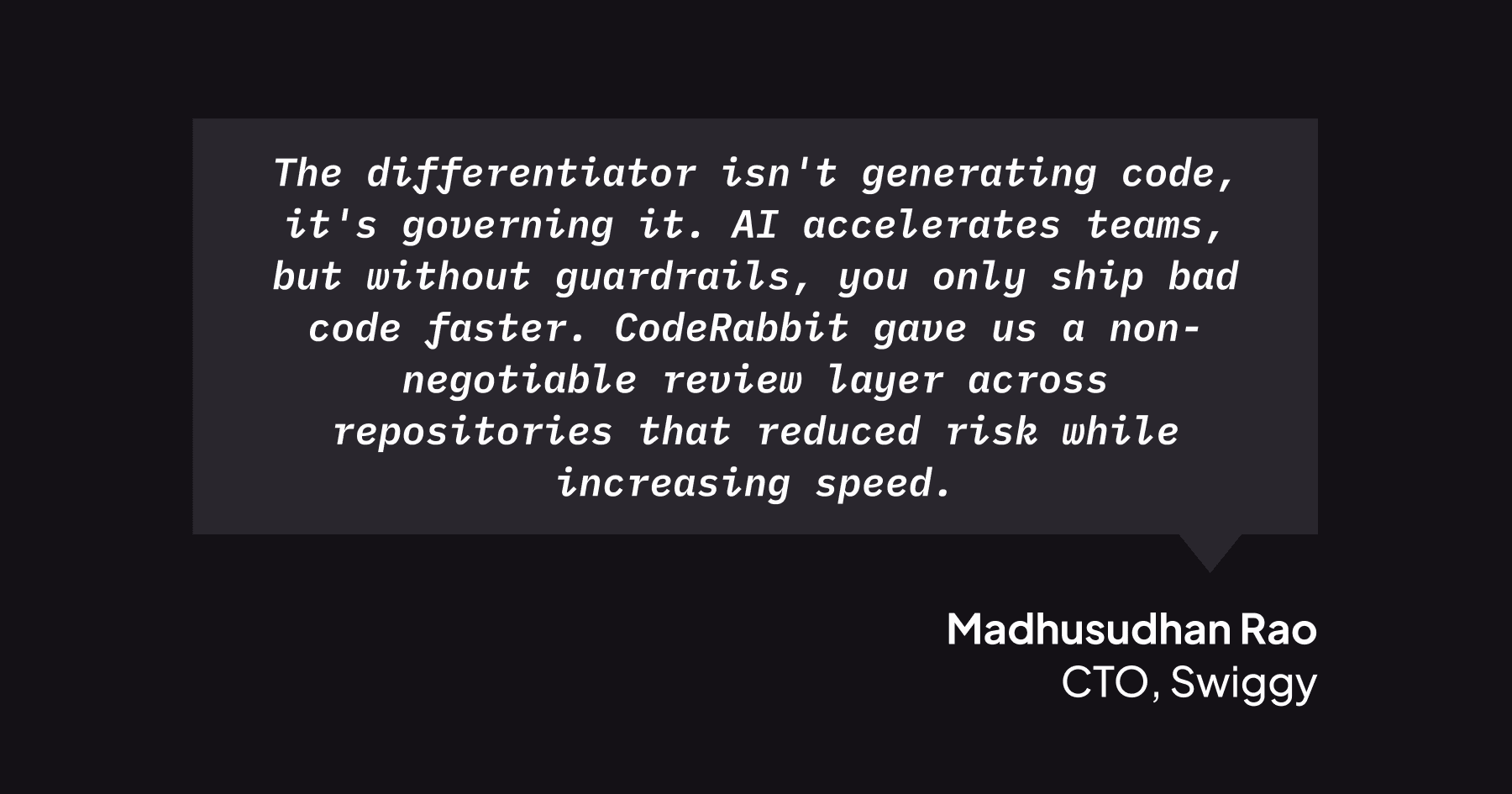
In hyper-growth environments, engineering velocity determines how fast the business can pivot. The real win wasn’t just speed — it was building a system where speed and reliability coexist.
- Madhusudhan Rao, CTO, Swiggy
That urgency led them to evaluate several AI review tools. After a detailed proof of concept, they chose CodeRabbit. CodeRabbit’s deep contextual understanding and proactive bug detection impressed them – and saved measurable time, money, and developer effort.
Challenge: Balancing speed, quality, and cost
Before CodeRabbit, Swiggy faced two major challenges that led them to seek out AI code review products.
Competitive pressure that required a faster deployment speed
In the food delivery space, Swiggy’s engineering organization is tasked with innovating rapidly, staying reliable, and managing costs effectively.
AI-assisted code generation increased our output, but it also increased risk. CodeRabbit became the stabilizing force, accelerating merges while preserving platform standards.
- Vivek Garg, VP Platform Engineering, Swiggy
Issues and downtime that were particularly costly for their consumer app
Fixing bugs that make their way into production is expensive for any company. Still, every second of downtime or customer issues has a direct impact on Swiggy’s bottom line, as consumers will simply order from another delivery app.
To reduce incidents and bugs, Swiggy previously invested in static analysis and security tools; however, pull requests still required manual reviews from two human developers. This caused delays and sometimes overlooked bugs.“The preliminary review primarily focuses on code hygiene, naming conventions, missed loggers, and interface misuse. Senior devs got bogged down by it, and junior devs were stuck waiting.” Even with rigorous processes, bugs were still missed and made it to production.
Delayed feedback compounds cost. With CodeRabbit running before human review, engineers received immediate, consistent input, eliminating backlog and reviewer fatigue.
- Vipin Tiwari, Sr Eng Director & Chief of Staff, Swiggy
70%
faster PR merges
30%
fewer review cycles
50%
fewer human reviewers
Why CodeRabbit
It outperformed other AI review tools by leveraging more context
Swiggy approached the search for an AI-powered code review tool methodically. The engineering team conducted formal proof-of-concept (POC) processes for three tools to assess their capabilities within their development environment.
Only CodeRabbit stood out."CodeRabbit wasn’t reviewing a PR in isolation; it was reviewing it in the context of the repository for which the PR was submitted,” said Satyam. That ability to review with contextual awareness was the key selling point for Swiggy.
At our scale, reviewing code file-by-file isn’t enough. We needed dependency awareness and context across services. Code graph analysis allowed feedback that actually understood our architecture.
- Vivek Garg, VP Platform Engineering, Swiggy
CodeRabbit ensured feedback is relevant and valuable with a high actionable comment rate. For example, CodeRabbit differentiated itself by understanding Swiggy's internal practices, like their custom logging library, "gocommons." During the POC, CodeRabbit identified an instance where the standard library logger was used instead of gocommons, a detail that even seasoned developers can easily overlook.
CodeRabbit found more bugs & issues
CodeRabbit discovered a secret that had been committed to the codebase, something that Swiggy’s existing security tooling had missed entirely. It wasn’t just a win for CodeRabbit’s detection capabilities; it revealed a significant portion of PRs that had critical issues before production, exposing a vulnerability to Swiggy's team that they had previously overlooked in their security checks.
“A secret was committed, but our tool failed to detect it. CodeRabbit found it,” shared Satyam. That single finding became a turning point not just for the evaluation but for Swiggy’s overall engineering priorities. As Satyam said, this led to deeper conversations with leadership about their security charter and the need for further investment in security priorities.
CodeRabbit was more comprehensive than other tools When they conducted multiple POCs with code review tools, Swiggy wanted to ensure the evaluation was comprehensive and unbiased. To accomplish that, the team ran a dual-track POC:
- Track 1: CodeRabbit was tested against live PRs from real Swiggy repositories.
- Track 2: An intern submitted PRs with poor coding practices, like violating naming conventions or writing complex logic, to test detection accuracy in a controlled environment.
CodeRabbit consistently identified solutions across nearly all our use cases, which ultimately solidified our confidence., said Satyam.
What also impressed Satyam was CodeRabbit’s architecture, which coordinates multiple models for layered reasoning and contextual analysis. That gave the Swiggy team confidence that this was not just another AI overlay; it was infrastructure-grade intelligence built for scale.
Swiggy’s POC was run for one and a half months with parallel tests using individual developer licenses. It was thorough. It was intentional. And it had a clear winner. “We were just checking if we can find something one tool does and the other doesn’t –and CodeRabbit won,” said Satyam.
Choosing CodeRabbit was not just a product decision; it was a cultural one. It meant Swiggy would scale engineering velocity with context and consistency without compromising in any way.
Junior engineers gained instant, aligned guidance on every PR, while seniors moved from syntax policing to strategic design conversations. That shift elevated the entire engineering culture.
- Vipin Tiwari, Sr Eng Director & Chief of Staff
Instant code hygiene
The first-pass review is often filled with minor but necessary nitpicks, misused loggers, incorrect interface names, and unnecessary complexity. These are tedious for senior devs to catch but critical to maintaining quality.
The thousands of comments that CodeRabbit flagged in just a few months would require significant manual review, slowing Swiggy’s ability to scale. Those comments translated into more than hundreds of real issues flagged and resolved early, preventing avoidable bugs and downstream review churn. “The first review isn’t about business logic,” explained Satyam.
“It’s just: Did you use the right logger? Is the interface named correctly? CodeRabbit handles that beautifully.” With this burden lifted, engineers can move faster, as the data shows that some developers had a 100% merge rate, suggesting trust and avoiding feedback cycles that once delayed merges.
But for Satyam, CodeRabbit does more than speed things up – it establishes a reliable standard. "CodeRabbit helps maintain Swiggy’s code standards.” In a company with over 1000 developers rapidly shipping features, consistency is invaluable for achieving success.
Governance isn’t about control, it’s about consistency. Monitoring skipped comments, tracking missed patterns and continuously evolving the system made AI review a living guardrail, not a static rulebook.
- Vivek Garg, VP Platform Engineering, Swiggy
Better PR summaries
Engineers want to ship, not write documentation and PR descriptions were often left blank or vague in the company. Now, with CodeRabbit auto-generating summaries, reviewers gain instant context. “Developers hate writing text. CodeRabbit generates PR summaries automatically. That alone saves a ton of time,” shared Satyam. That quick clarity speeds up approvals and reduces confusion.
Results: Improved velocity, safer code
From day one, CodeRabbit wasn’t just another tool in Swiggy’s stack. It became a trusted set of eyes across hundreds of PRs, helping eliminate the friction of repetitive manual checks while reinforcing engineering standards at scale. In the past year alone, CodeRabbit has reviewed thousands of pull requests across Swiggy’s engineering organization, operating at production scale continuously.
CodeRabbit became the first reviewer
Due to the outstanding results Swiggy has achieved with CodeRabbit, they’re implementing a new approval workflow that positions CodeRabbit at the center of the development process. Now, every pull request needs three approvals before merging: two from developers and one from CodeRabbit. Since making CodeRabbit the mandatory first reviewer, Swiggy has seen a 70% reduction in average PR merge time, significantly accelerating feature delivery. This isn’t just an extra step – it builds trust in automation and paves the way for faster engineering velocity.
I’ve made it mandatory that no PR goes to a senior dev unless CodeRabbit has approved it," Satyam stated.
“That approval means hygiene is done.” CodeRabbit now conducts the first-pass review, catching missing loggers, naming convention issues, and other hygiene concerns that would slow senior engineers. With a high actionable comment rate, the feedback is meaningful, rather than just noise. This allows human reviewers to focus on business logic, architecture, and feature readiness, rather than technical details.
CodeRabbit has replaced one human reviewer
Based on their success with CodeRabbit, Swiggy reduced the number of human reviewers per PR from two to one, pairing each with CodeRabbit’s automated checks. This incremental rollout is already live on select repositories and has started freeing up senior developers who were earlier stuck in review cycles. “They can work on new features, simplify designs, and build more scalable systems,” said Satyam. “We translate developer bandwidth into dollar value here.” By removing repetitive back-and-forth, this workflow has eliminated an average of 30% review cycles per pull request, freeing senior engineers to focus on domain modeling, architecture and more.
That time and cost efficiency isn’t theoretical. Moving from two manual reviews to one without compromising quality means increased throughput per dollar, greater momentum per sprint, and, ultimately, a faster time to market in a hyper-competitive space. It’s a deliberate move, but the goal is clear: a high-trust, AI-powered workflow that moves as fast as Swiggy needs to.
CodeRabbit didn’t replace reviewers; it amplified them. The result was fewer cycles, fewer escaped issues, and dramatically better utilization of senior engineering bandwidth.
- Vipin Tiwari, Sr Eng Director & Chief of Staff, Swiggy
Less downtime, bugs & issues
CodeRabbit successfully identified critical issues that others had overlooked. Swiggy understood the value of CodeRabbit when a missed null pointer exception caught by CodeRabbit but ignored by a developer made its way into production, leading to an outage. Given how much business Swiggy could lose to its competitors in just a few minutes of downtime, having CodeRabbit review its code gives the Engineering team more peace of mind.
IDE integration catches bugs earlier
Beyond GitHub, Swiggy’s team has also adopted the CodeRabbit extension in VS Code and Cursor, enabling inline AI feedback as they write code. This ensures they’ll catch issues even before a PR is created, bringing AI-powered quality checks closer to the source.
CodeRabbit = Shipping features faster & with more confidence
Before CodeRabbit
- Senior engineers were bottlenecked, and minor issues caused unnecessary delays.
- Pull requests required manual reviews from two human developers.
- Bugs were still missed and made it to production.
After CodeRabbit
- 70% reduction in average PR merge time.
- Eliminated an average of 30% of review cycles per pull request.
- Reduced the number of human reviewers per PR from two to one.
By integrating CodeRabbit into both the code review process and their IDE, Swiggy has experienced fewer bugs, faster iterations, and a smoother engineering experience. With hundreds of developers using the tool across dozens of repositories, CodeRabbit is now deeply ingrained in how Swiggy builds and ships software. Developers use it daily to identify hygiene issues, suggest improvements, and speed up reviews, saving time across the engineering team.
“Every dollar we save is a dollar we can invest in the business,” said Satyam. Those time and cost savings are critical in a space with short release windows. With fewer blockers and more confidence in their codebase, the team is building at the speed of the market. “Code reviews are no longer a bottleneck,” explained Satyam.“AI-powered insights help us catch issues early, and the team can focus on writing better code rather than spending too much time reviewing.” For Swiggy, CodeRabbit isn’t just helping its engineering team—it’s fueling its growth.
In the long term, AI-powered code reviews won’t be optional. They’ll be foundational infrastructure, like CI/CD is today.
- Madhusudhan Rao, CTO, Swiggy

Bengaluru, India
https://www.swiggy.com/Industry
Food delivery and quick commerce
Challenge
Scaling code quality in a fast-paced, high-stakes engineering environment without slowing delivery


